Stories beside writing
Writing can frame a picture, carry a story beyond its edge, or share the surface as visible form. These four works connect a talking parrot, a musical mode, a sacred birth, and an epic battle with different kinds of text. Notice the physical page and its divisions before assuming that every picture illustrates the same kind of narrative.
Begin the journey ↓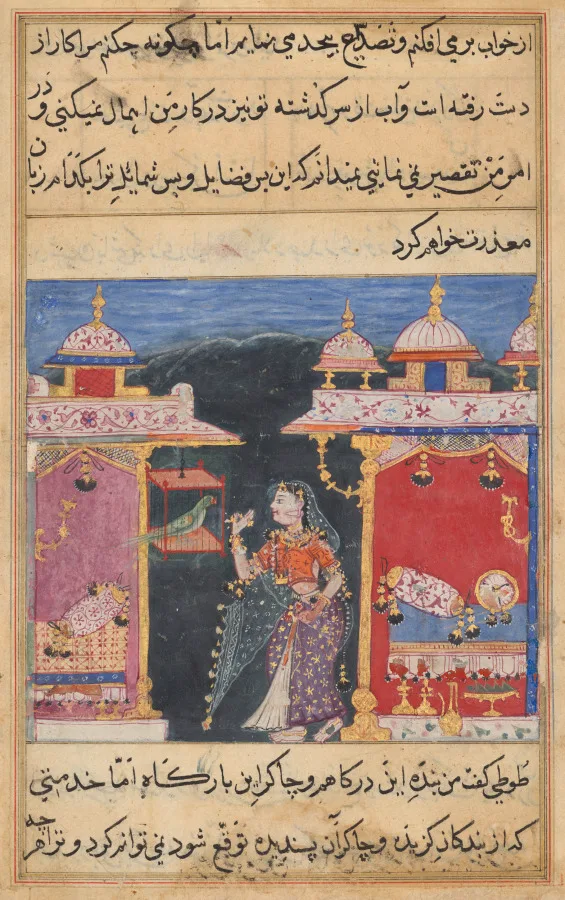
A speaker who delays the story
The small parrot and the woman share a setting framed by writing. The bird’s narrative role depends on the museum’s account, while its visible placement makes the conversation’s participants identifiable.
Carry this question: How does the small bird organise attention within the room?
Open the artwork ↗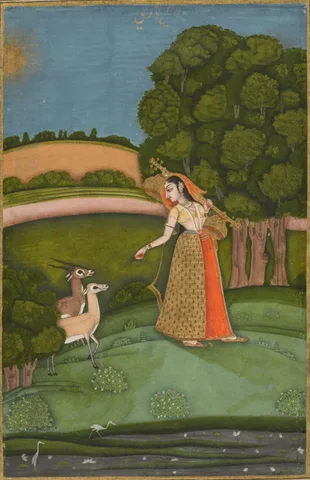
Music pictured through a figure
The instrument and attentive deer help turn a musical association into a visible scene. The image is not a transcript of sound, so its seasonal and musical context must remain distinct from direct observation.
Carry this question: What can a painted instrument suggest without letting us hear it?
Open the artwork ↗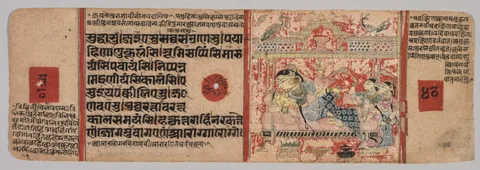
A sacred birth on a working page
The mother and infant form the narrative centre, while a binding hole and marginal additions remind us that this is a manuscript leaf. The story and the object’s use share the surface.
Carry this question: What does the binding hole reveal that the scene alone cannot?
Open the artwork ↗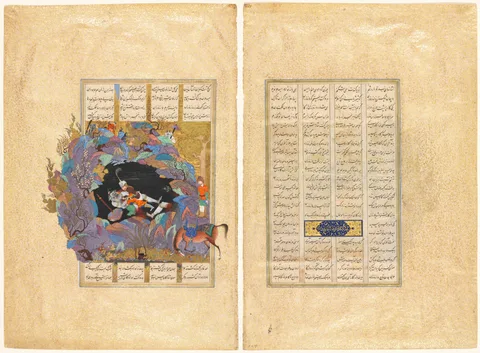
An epic within a luxury manuscript
The dark cave concentrates a violent encounter while brilliant rocks press against the text frame. The selected museum image includes two sides, so separate the pictured episode from the whole photographic composite.
Carry this question: Where does the painting push beyond the ruled writing field?
Open the artwork ↗Read with the sources
Historical context follows the individual museum records linked on each artwork page. These routes make original comparisons of visible form; resemblance alone is not evidence of shared meaning or direct influence.
- The Parrot Addresses Khujasta at the Beginning of the Seventh Night, from a Tuti-nama (Tales of a Parrot) — museum collection record
- Todi Ragini, from a Ragamala Series — museum collection record
- Birth of Mahavira, folio 40 (verso) from a Kalpa-sutra — museum collection record
- Rustam's seventh course: He kills the White Div, folio 124 from a Shah-nama (Book of Kings) of Firdausi (Persian, about 934–1020) — museum collection record