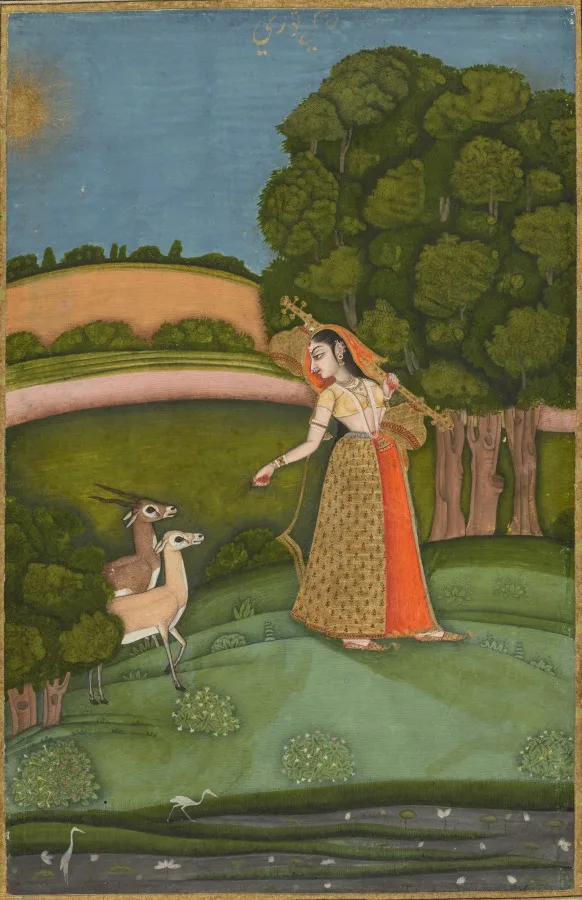
A musician’s outstretched hand and two attentive deer make a musical mood visible through a small encounter in a landscape.
Follow the woman’s extended arm toward the deer. Their raised heads answer her gesture, joining musician and animals across the green clearing. The museum identifies this as Todi Ragini, part of a ragamala series in which paintings evoke musical associations, seasons, and times of day. Here the setting suggests a late morning in spring, and the woman’s music draws deer away from crops. A seemingly gentle encounter therefore has a particular narrative purpose.
The curved bands of field and wooded ground give the figures a sheltered place within a wider landscape. Saturated greens, pinks, and orange hold the scene together without turning it into a botanical or agricultural diagram. The museum connects its romantic presentation with Mughal artistic ideas circulating to Murshidabad. It also notes an identifying inscription in Arabic script and suggests a Muslim patron. That proposed patronage comes from documentary features, while the encounter among gesture, instrument, and listening animals remains the most immediate visual invitation.
The proposed Muslim patron is an inference from the inscription, not a named person established by the image. The painting evokes a musical mode and mood; it cannot supply the sound of a particular performance.