Read the
Picture
An open collection
Iran, Tabriz, Safavid period (1501-1722) · Manuscript

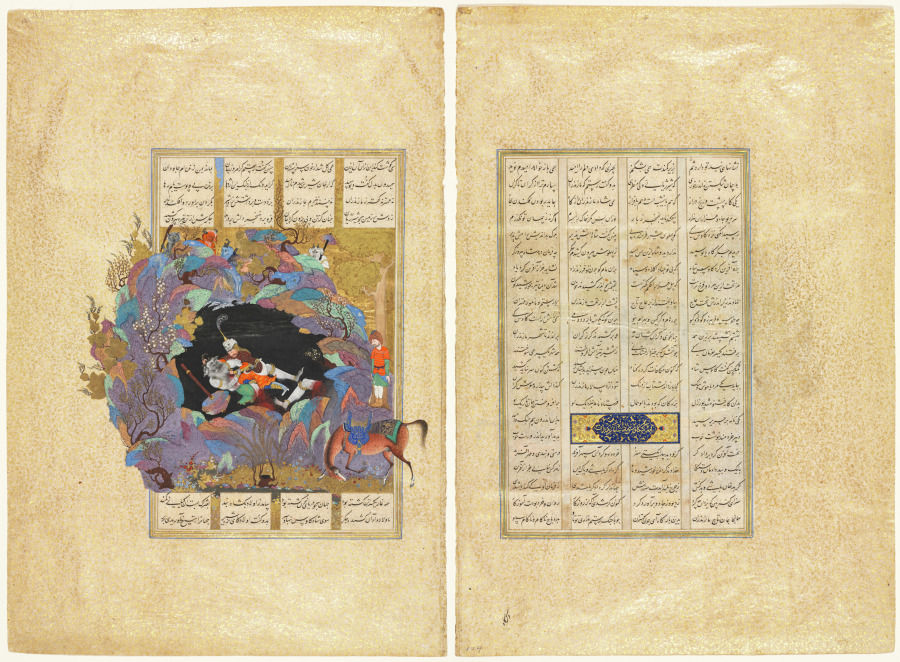
Rustam's seventh course: He kills the White Div, folio 124 from a Shah-nama (Book of Kings) of Firdausi (Persian, about 934–1020)

attributed to Mir Musavvir (Iranian, c. 1510–1555); attributed to Abd al-Vahhab (Persian, active c. 1516) · 1520–37

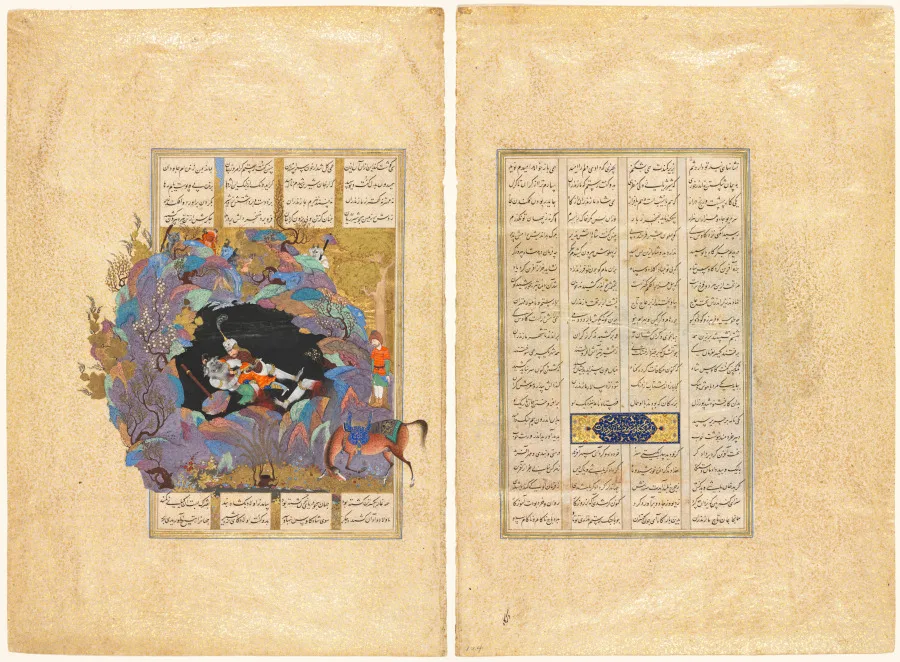
A museum image shows two manuscript sides together. On the left, columns of Persian writing surround a colourful rocky landscape with a black cave at its centre. Rustam wrestles a pale demon inside the cave; a horse and standing figure appear nearby. The right side contains columns of writing and a small blue-and-gold panel.
100%

Drag to move · Pinch or +/− to zoom · Arrow keys to pan · 0 to reset

The Cleveland Museum of Art · 1988.96 · Image: CC0Museum image ↗
A little context

A dark cave concentrates a violent encounter, while brilliant rocks and elegant writing place it inside a luxury epic manuscript.

The darkest area of this manuscript painting is also its narrative centre. Inside a black cave, Rustam struggles with the White Div, a demon from the Shahnameh, the Persian Book of Kings. The museum explains that the hero needs the demon’s liver blood to cure his king’s blindness. This is a violent episode, framed by unusually delicate flowers, fantastic coloured rocks, and carefully organised writing.

The page belonged to the celebrated Shahnameh made for the Safavid ruler Shah Tahmasp. Its refined materials and colour belong to a courtly manuscript culture, even when the story itself is brutal. The museum traces its history through Tahmasp's gift to the Ottoman sultan Selim II in 1567; this folio entered Cleveland's collection in 1988. Follow how the painted landscape presses beyond parts of the text frame: reading and looking share the page. The current photograph presents two manuscript sides together, with the scene on the left. The attributions to named artists remain qualified, so the page should not be treated as a securely signed individual achievement.

A careful reading

This episode includes violence. The museum qualifies the attributions to Mir Musavvir and Abd al-Vahhab; neither should be presented as certain. The composite photograph shows two manuscript sides, not one continuous illustrated scene.
Try your eye

What makes the black cave important to the composition?

Where this reading begins

Our observations describe the supplied museum photograph. Historical identifications and context follow the cited collection record; interpretive limits are stated above. This is an independent guide, not a museum endorsement.

Image rights & attribution

Rustam's seventh course: He kills the White Div, folio 124 from a Shah-nama (Book of Kings) of Firdausi (Persian, about 934–1020), 1520–37. Attributed to Mir Musavvir (Iranian, c. 1510–1555), attributed to Abd al-Vahhab (Persian, active c. 1516). Gum tempera, ink, gold, and silver on paper; sheet: 47.5 x 32.2 cm (18 11/16 x 12 11/16 in.); image: 28.4 x 18.5 cm (11 3/16 x 7 5/16 in.). The Cleveland Museum of Art, Leonard C. Hanna Jr. Fund, 1988.96

Individual API record marked CC0; checked 2026-11-13. CC0 1.0 dedication. Record date: 2026-05-29 07:58:45.033000. Web JPEG downloaded unchanged; responsive WebP and zoom derivatives resized and recompressed; numbered annotation overlay separate from image.