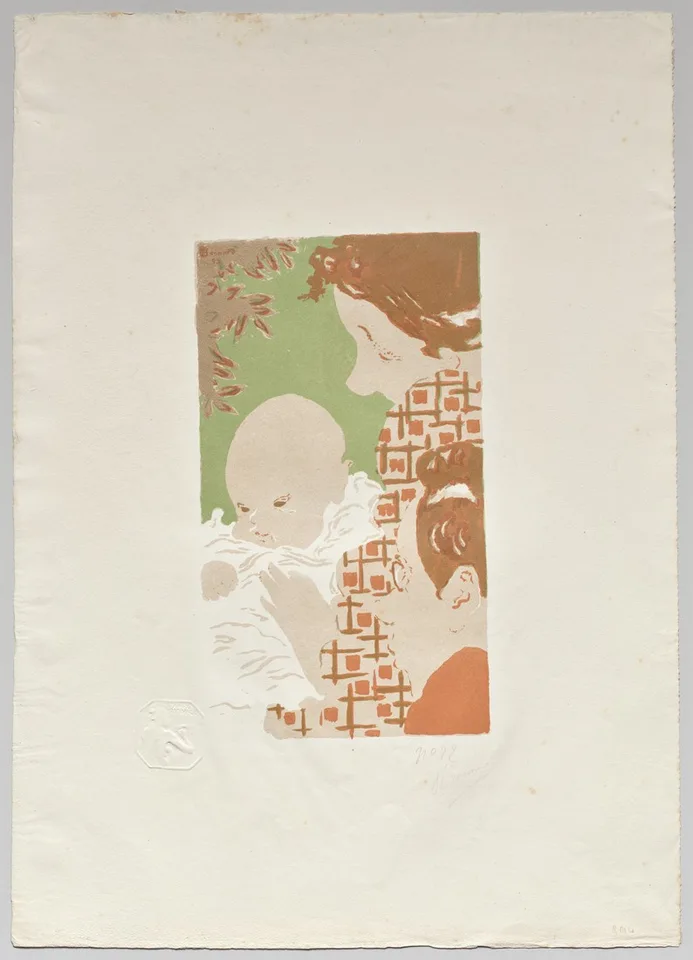
A baby is surrounded by cropped faces and patterned cloth, making family intimacy depend on what the frame leaves out.
The infant’s pale head stands out against green, while the adults enter only partially. The woman above bends toward the child, and the lower head turns inward from the right. The image gives almost no room to a wider interior. Instead, the repeated rust-colored pattern connects the closely fitted bodies and keeps the surface visibly flat.
Bonnard depicts his sister Andrée and her son Jean, and includes himself at the lower right. The museum connects the abrupt cropping and flat planes of color with his interest in Japanese woodblock prints. This is a color lithograph, however, so an influence on arrangement should not be confused with use of the same printing technique. Its domestic intimacy comes from compression: faces, infant, and cloth share a narrow field. The wide paper margin around that field makes the difference between the small printed encounter and the whole physical sheet especially clear.
The image’s Japanese-print influence concerns composition; this object is a lithograph. The cropped family scene should not be treated as a complete record of the room or occasion.