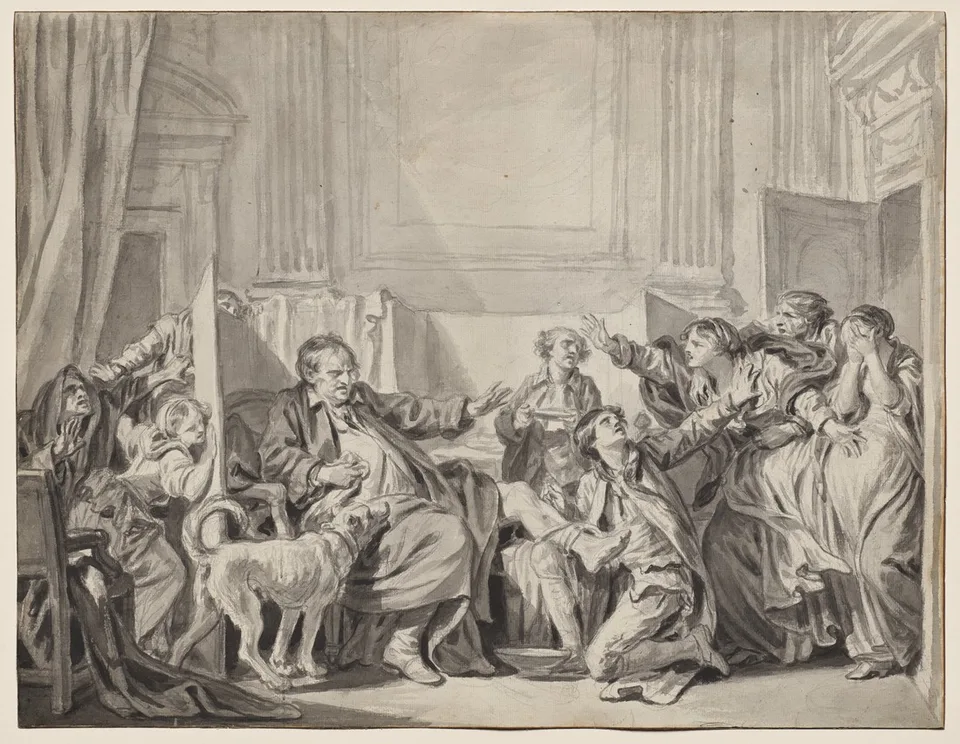
Many arms make accusations and appeals, but the family drama’s exact story remains less secure than its emphatic gestures.
The room is shallow enough that nearly every action can be read across the foreground. A seated older man extends his hand, a younger figure kneels in front of him, and an entering woman points toward the family. At the far right, another young woman lowers her face into her hands. Repeated diagonals connect these people before we know precisely what has happened.
Greuze made a group of highly finished drawings of family crises in the 1770s. The museum explains that this title derives from an inscription on the original frame and that the exact subject is unknown. It proposes a pregnancy outside marriage and a confrontation about responsibility, while retaining uncertainty over which man is accused. Those qualifications matter because the gestures are more secure than the plot. We can describe appeal, distress, and confrontation without treating a suggested narrative as an eyewitness account of a real household.
The title and proposed pregnancy narrative do not securely identify the event. The museum leaves the exact subject and the accused man uncertain despite the emphatic gestures.