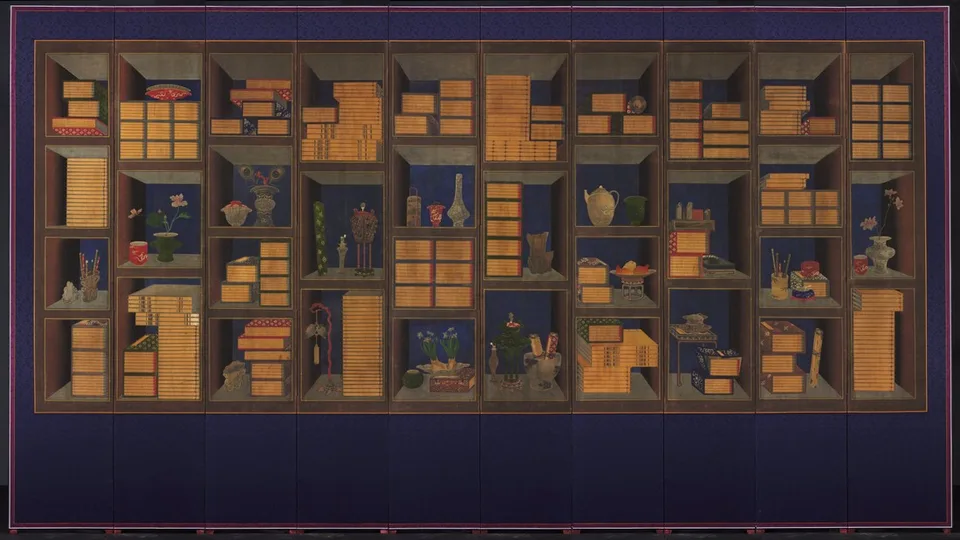
Painted shelves offer the appearance of a learned interior, even though every book and treasured object remains on a flat screen.
The shelves invite an inventory, but their geometry deserves attention first. Angled side walls and shaded compartments suggest depth across a flat folding screen. Stacks of books repeat in changing orientations, while vases, flowers and scholarly accessories interrupt the rhythm. The result is a room furnished with the appearance of possessions, even when the actual objects are absent.
The museum identifies this as chaekgado, pictures of bookshelves, a genre that flourished as a royal emblem before becoming popular in aristocratic studies. A hidden seal in the third panel from the right identifies Yi Taek-gyun, a court painter. The screen therefore speaks both about learning and about its visible presentation. It should not be treated as the literal contents of one known library. The possible wider history of illusionistic cabinet painting is a research hypothesis, while the constructed depth and repeated books are immediately visible.
The screen is not an inventory of an identified owner’s library. Proposed connections with other illusionistic painting traditions remain hypotheses, and the hidden seal is difficult to read at overview scale.