Read the
Picture
An open collection
Japan, Momoyama period (1573–1615) · Ceramic

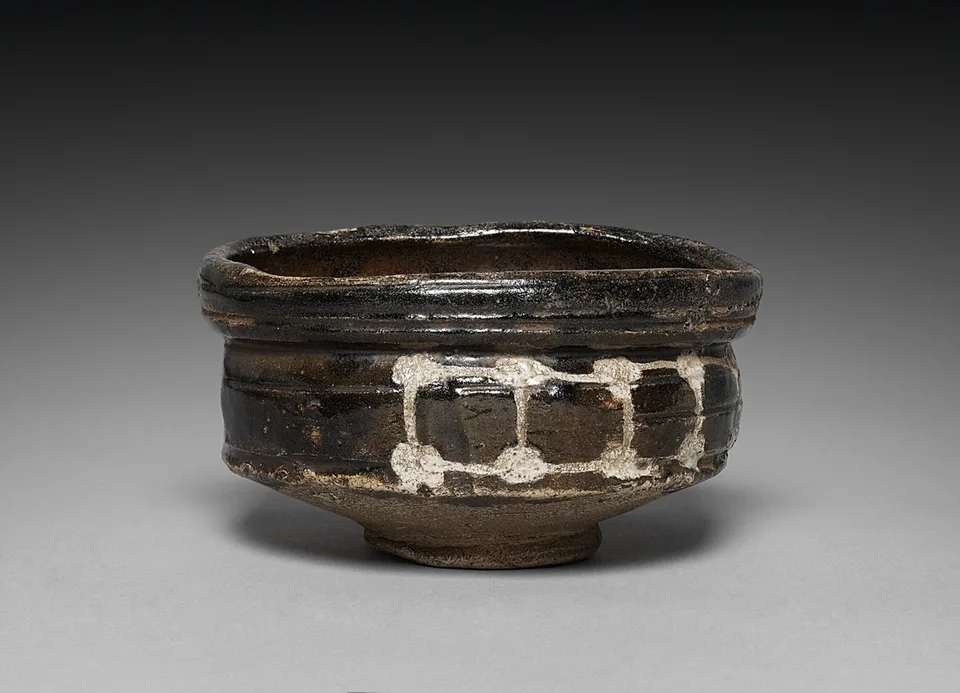
Clog-shaped Teabowl

Maker unrecorded · early 1600s

A low dark ceramic bowl has an oblong, uneven opening and a thick rounded rim. Pale roughly rectangular markings form a loose band on its front wall. Dark glaze drips and varies in sheen, while a small foot lifts the broad, slightly compressed body above the grey surface.
100%

Drag to move · Pinch or +/− to zoom · Arrow keys to pan · 0 to reset

The Cleveland Museum of Art · 2020.214 · Image: CC0Museum image ↗
A little context

An uneven opening and bold pale rectangles make this tea bowl’s deliberate irregularity the first thing your eye notices.

The mouth does not form a perfect circle, and the pale band does not behave like a mechanically repeated pattern. Its rectangles vary in width and spacing across the dark wall. Together with the compressed body and heavy rim, they make the bowl’s irregularity feel deliberate rather than accidental. The small foot gives the broad form a point of balance.

The museum identifies an Oribe-style tea bowl from the early seventeenth century. The term is associated with the tea master who promoted this aesthetic, while the word itself originally referred to a government office concerned with textiles. Tea practice gives the vessel a context of handling and close attention, but the photograph cannot reproduce its weight, texture or use in a gathering. It can show how a practical bowl makes asymmetry and abstract design central to the act of looking.

A careful reading

The style’s association with a tea master does not identify the individual potter. A photograph cannot reproduce the tactile and social experience of using the bowl in tea practice.

Try your eye

Which combination best expresses the bowl’s deliberate irregularity?

Where this reading begins

  • Clog-shaped Teabowl — collection record — The Cleveland Museum of Art. Supports dating, materials, attribution, provenance and the contextual reading; observations describe the individually inspected museum photograph. Museum record updated 2026-05-29; accessed 2026-11-14.

Our observations describe the supplied museum photograph. Historical identifications and context follow the cited collection record; interpretive limits are stated above. This is an independent guide, not a museum endorsement.

Image rights & attribution

Clog-shaped Teabowl (黒織部沓形茶碗), early 1600s. Japan, Momoyama period (1573–1615). Glazed stoneware (Mino ware, Oribe type); overall: 8 x 14.2 x 11.5 cm (3 1/8 x 5 9/16 x 4 1/2 in.). The Cleveland Museum of Art, Severance and Greta Millikin Purchase Fund, 2020.214

Individual API record marked CC0; checked 2026-11-14. CC0 1.0 dedication. Record date: 2026-05-29 08:58:54.708000. Museum print JPEG downloaded unchanged and retained; complete overview resized and recompressed as JPEG; responsive WebP and zoom derivatives resized and recompressed; numbered annotation overlay separate from image.