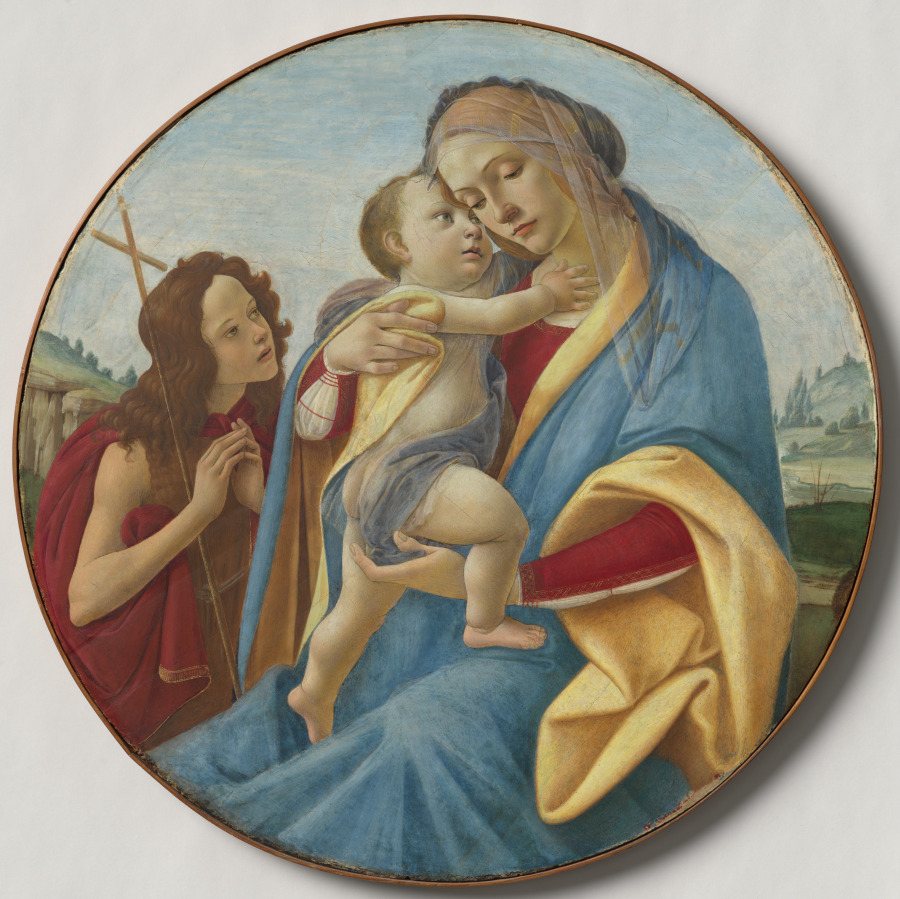
Three figures fit within a circle through linked hands, bending heads, and broad folds of blue fabric.
The circle supplies a problem the figures seem to solve. Mary bends inward, the child stretches across her body, and the young John enters from the left without breaking the curved boundary. Their hands and faces create a compact network of contact. A distant landscape opens behind them, but the encounter remains close and physically tender.
The museum explains that round paintings, or tondi, became popular for Florentine domestic settings during the fifteenth century. It attributes this work to Botticelli and Workshop, preserving an important distinction between a master’s involvement and collective production. Specialists have debated particular passages, and Mary’s blue garment is both heavily restored and thought likely to involve another studio hand. Such information does not make the circle less coherent. Instead, it asks us to look at the finished composition while recognizing that its present unity can include collaboration, later treatment, and continuing scholarly disagreement about who painted each part.
Keep “and Workshop” in the attribution. The museum distinguishes likely studio participation and heavy restoration in the blue garment; a screen image cannot securely assign each brushstroke to an individual painter.
Which attribution best preserves the museum’s position?
Practise looking at Virgin and Child with the Young Saint John the Baptist →