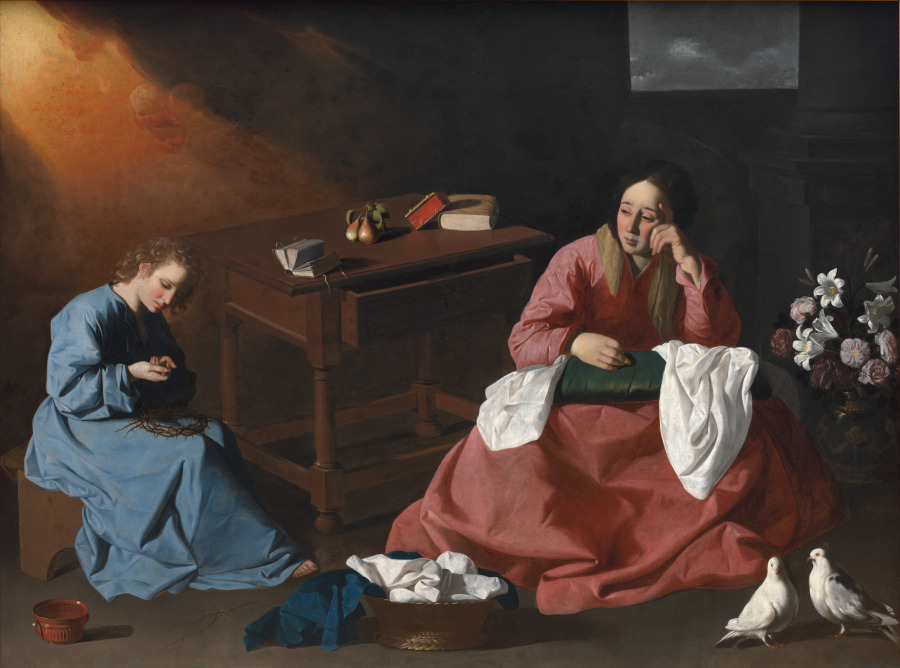
A quiet household scene contains a painful forecast, carried by a small crown of thorns and a mother’s arrested work.
The room is still, but its figures are not simply resting. The young Jesus looks toward his hand above a crown of thorns, while Mary pauses with fabric across her lap. Their separation leaves space for a table, books, and fruit. Light enters from the upper left and concentrates attention on faces, hands, and pale cloth rather than illuminating every corner equally.
The museum explains that Zurbarán appears to have invented this scene rather than illustrating a specific biblical episode. Jesus pricks himself while weaving the thorn crown, anticipating his later Crucifixion. Such accessible images of Christ’s childhood and adolescence became popular during the Counter-Reformation. That context helps explain the painting’s combination of ordinary domestic objects and sacred prediction. Look between the young figure’s hands and Mary’s face: a small injury is given a larger meaning through their relationship, while the household setting makes the subject physically immediate without turning it into a documented family event.
The museum treats the episode as apparently invented by the painter, not a biblical passage. The anticipatory meaning is contextual; do not assign an unsupported symbolic interpretation to every household object in the room.
How does this scene relate to biblical narrative?
Practise looking at Christ and the Virgin in the House at Nazareth →