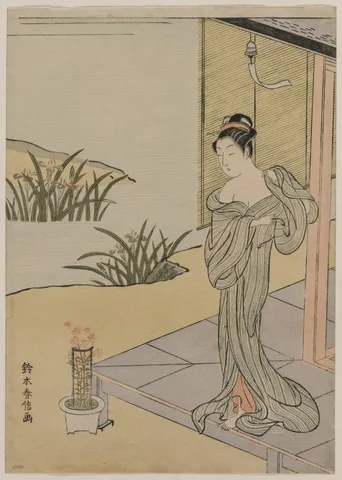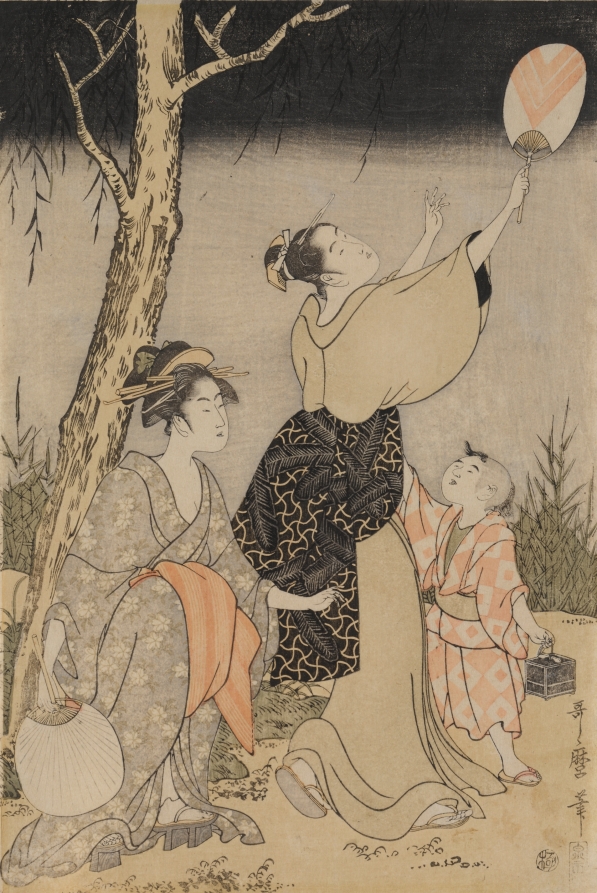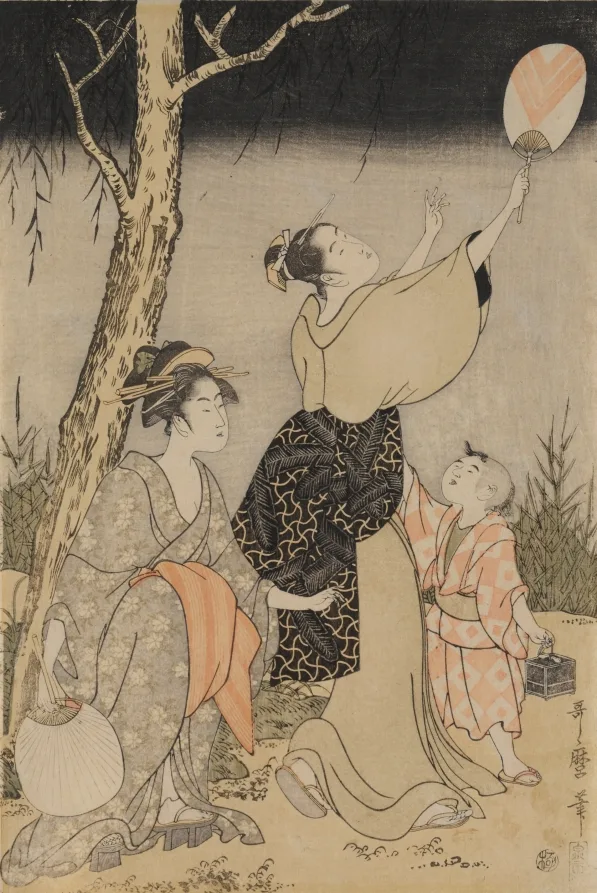
A raised fan, fluttering sleeves, and a small carrying cage make an evening pastime legible in one panel of a larger scene.
The tallest gesture is the best starting point: a woman lifts her fan into the darkening air. The curve of her body and the spread of her sleeve carry the eye upward, while a child with a small cage anchors the lower right. The museum identifies the larger composition as a lively pursuit of fireflies, with movement conveyed partly through fluttering clothing.
This image is the left panel of a triptych. The museum’s description refers to actions across that larger scene, so not every mentioned participant appears in this selected view. Staying with what is visible, compare the raised fan, the lower fan, and the cage as different objects within the same activity. They help a reader recognise pursuit, anticipation, and capture without needing a large close-up of an insect. The print also shows how a fragment can remain understandable while retaining connections beyond its edge. Its social setting differs from a scientific illustration intended to identify firefly species.
This is one panel of a triptych, and the museum’s description also discusses figures outside this view. The tiny insects are not used here to identify species or reconstruct an exact natural event.
Why might a museum description mention a person we cannot find in this image?
Practise looking at Catching Fireflies Beneath a Willow Tree (left) →