Read the
Picture
An open collection
Japan, Edo period (1615–1868) · Print

Sōjō Henjō

Suzuki Harunobu (Japanese, 1724–1770) · c. 1766

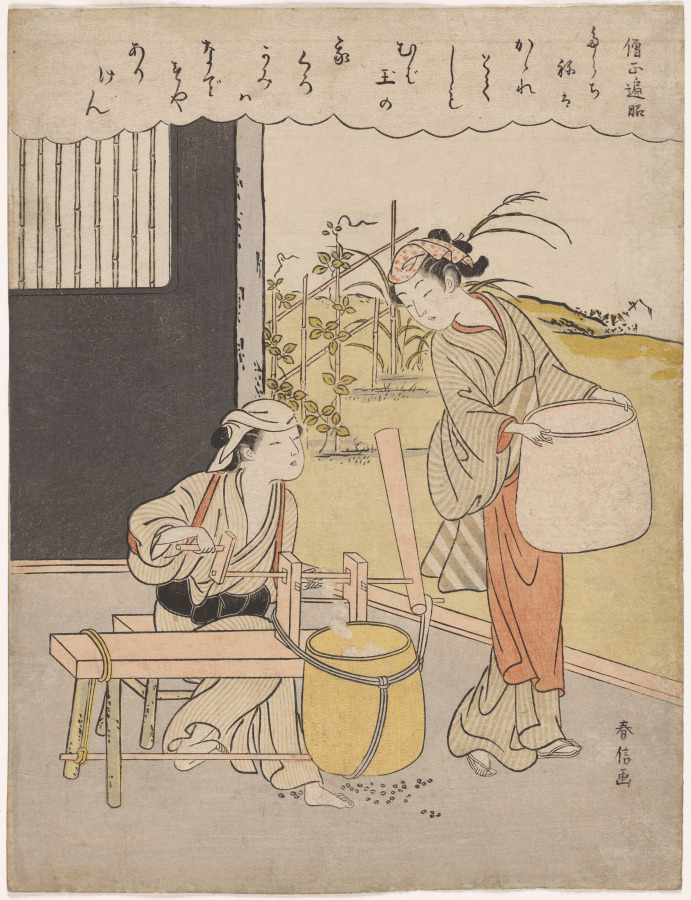
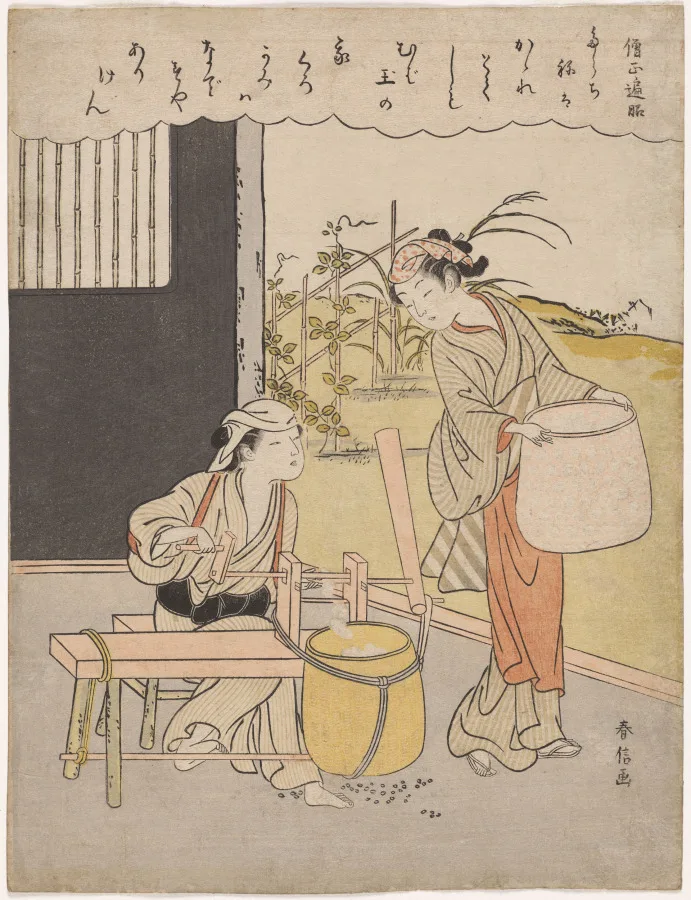
Two women work beside a low cotton-ginning device. One sits with her hands at the wooden mechanism, while the other stands holding a large basket. Pale cotton lies near the rollers and in a container below. Small dark seeds scatter on the ground. A band of calligraphy runs across the top of the print.
100%

Drag to move · Pinch or +/− to zoom · Arrow keys to pan · 0 to reset

The Cleveland Museum of Art · 2026.47 · Image: CC0Museum image ↗
A little context

Two workers and a seed-separating machine give a classical poem an unexpected new setting in textile labour.

Follow the cotton from the standing woman’s basket toward the seated worker’s machine. The low device separates seeds from fibres, making an everyday material process the centre of the scene. Small dark marks on the ground are easy to overlook, but they become important once the museum explains the relationship between the picture and the poem above it.

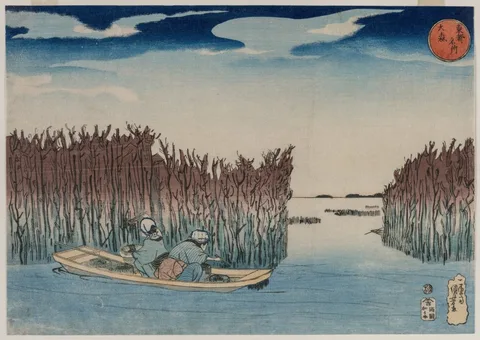
The poem is associated with a Buddhist monk and compares hair cut on entering religious life with dark lily seeds. Harunobu substitutes cotton seeds within a scene of women working. The connection is a visual and literary transformation, not a literal illustration of the monk at his ordination. This gives the print two linked kinds of interest: an intelligible action involving tools and materials, and a playful reinterpretation for readers who knew the poem. Compare Hokusai’s Rice Fields and Emperor Tenchi, another case in which labouring figures bring older poetry into a newly imagined everyday setting.

A careful reading

The poem’s seed-and-hair comparison comes from the museum’s interpretation of the inscription. The workers are not identified historical portraits, and the scene does not document a particular monk’s entry into religious life.
Try your eye

How does the picture transform the poem’s imagery?

Where this reading begins

  • Sōjō Henjō — collection record — The Cleveland Museum of Art. Supports identification, dating, materials, authorship qualifications and contextual interpretation; close-looking observations describe the individually inspected museum photograph. Museum record updated 2026-10-07; accessed 2026-11-13.

Our observations describe the supplied museum photograph. Historical identifications and context follow the cited collection record; interpretive limits are stated above. This is an independent guide, not a museum endorsement.

Image rights & attribution

Sōjō Henjō (僧正遍昭), c. 1766. Suzuki Harunobu (Japanese, 1724–1770). Color woodblock print. The Cleveland Museum of Art, The Kelvin Smith Collection, given by Ellen and Bruce Mavec, 2026.47

Individual API record marked CC0; checked 2026-11-13. CC0 1.0 dedication. Record date: 2026-10-07 12:13:23.379000. Web JPEG downloaded unchanged; responsive WebP and zoom derivatives resized and recompressed; numbered annotation overlay separate from image.