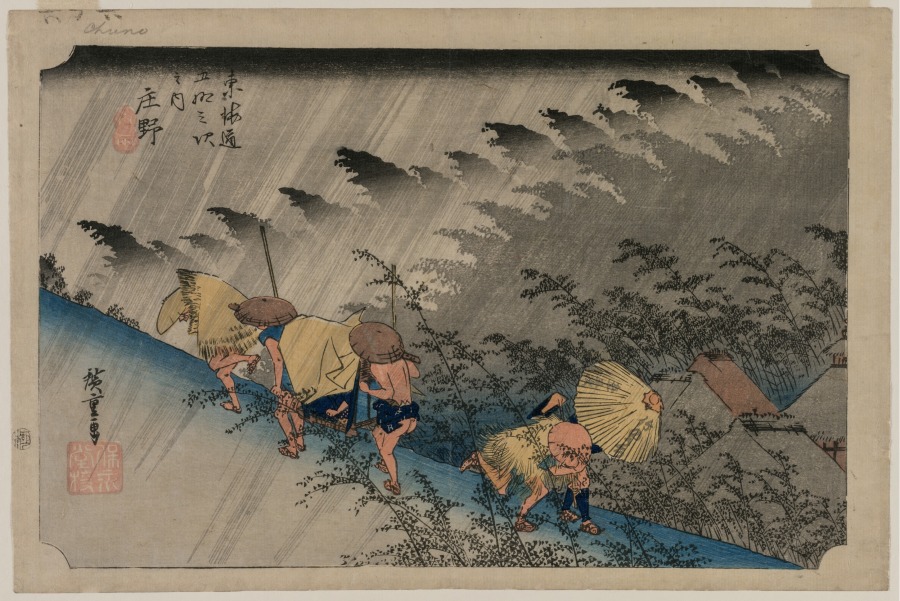
Bent travellers and three shades of bamboo turn a roadside downpour into a lesson in the construction of printed atmosphere.
The rain does not fall gently through a stable view. It slants across the print while bodies lean, umbrellas tilt, and bamboo forms seem to bend with the weather. The road’s diagonal gives the travellers a difficult route through the scene. The museum identifies Shōno as a minor station on the Tōkaidō road between Kyoto and Edo.
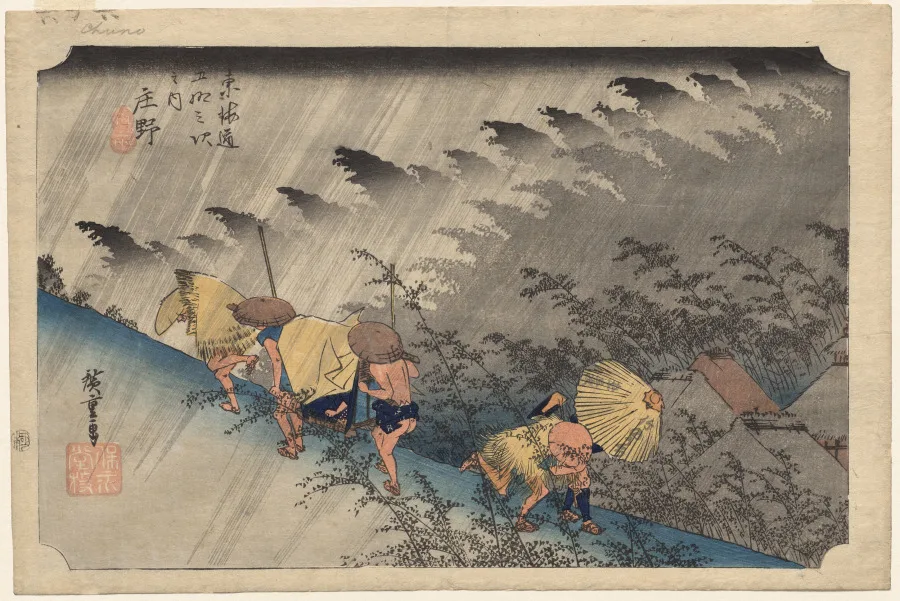
Look beyond the foreground movement to the bamboo. Three shades of grey create successive layers, and the museum explains that these required three separate printing blocks. Atmosphere is therefore also a technical achievement in the organisation of colour. The umbrella carries another kind of information: the publisher’s name and part of the series title are worked into the depicted object. This makes the image both a view of travel and a commercial print with its own production history. Compare Sudden Shower over Shin-Ōhashi Bridge, where urban architecture gives a different structure to a similarly temporary burst of weather.
The print is a designed view of a road station, not a measured record of a particular storm. The museum identifies the blocks and umbrella lettering; these cannot all be inferred from weather effects alone.
How did the print create the three grey layers in the bamboo?
Practise looking at Driving Rain at Shōno, from Fifty-Three Stations of the Tokaidō →