Air, work, and season
A paper strip can suggest a breeze, while bent bodies and slanting lines can suggest a downpour. Between those extremes, these prints show cotton processing, firefly catching, and seaweed cultivation. Follow the interaction of bodies, tools, and surroundings before deciding whether a landscape is merely a backdrop.
Begin the journey ↓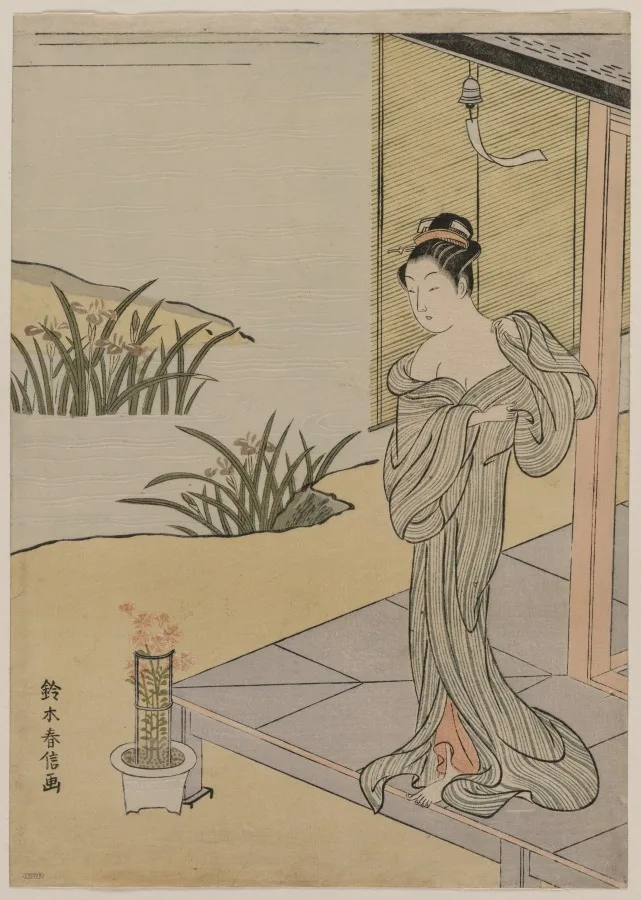
Begin with a slight movement
The strip beneath the windbell curves in a warm breeze. The quiet sign of air differs from storm imagery, while the museum’s embossing record points to a tactile effect the screen cannot fully reproduce.
Carry this question: How little movement is needed to establish a breeze?
Open the artwork ↗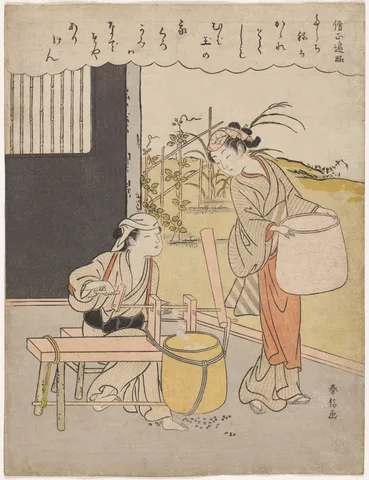
Labour meets a poem
The machine separates cotton seeds from fibres. Those seeds also connect with an older poem’s imagery, so an intelligible everyday process becomes a literary transformation rather than a literal illustration.
Carry this question: What remains visible before you know the poem?
Open the artwork ↗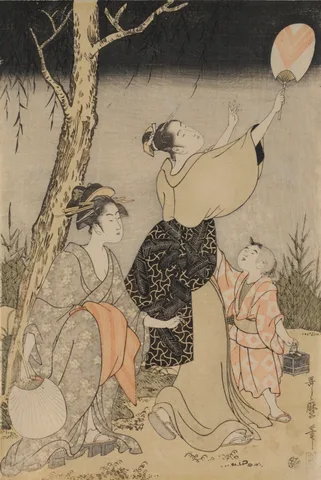
A pastime crosses panel edges
The lifted fan and child’s cage make pursuit and capture readable. Remember that this is one triptych panel: the wider museum description includes people and actions beyond this selected view.
Carry this question: How do the objects establish the pastime without a close-up insect?
Open the artwork ↗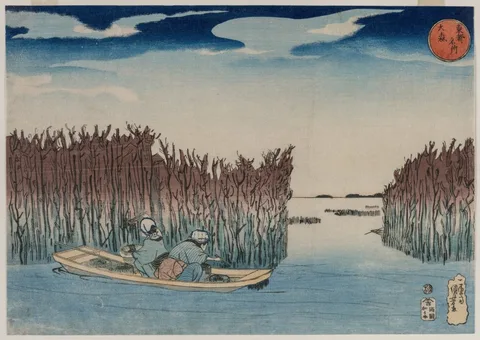
A landscape organised by production
Rows of growing beds enclose the workers’ boat. The water is route and workplace together, making a famous-place view also an image of the labour behind a familiar food.
Carry this question: What tells you this is cultivation rather than wild shoreline?
Open the artwork ↗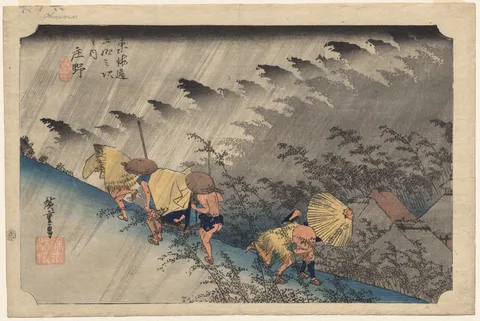
Printing the depth of rain
The bamboo recedes through three grey tones made with separate blocks. The weather effect has a production history, while lettering on an umbrella connects the scene with its publisher.
Carry this question: How does knowing the printing method change your view of the atmosphere?
Open the artwork ↗Look at a pair more closely
- Work makes a landscape
Cotton ginning and nori gathering in Japanese prints
Read with the sources
Historical context follows the individual museum records linked on each artwork page. These routes make original comparisons of visible form; resemblance alone is not evidence of shared meaning or direct influence.
- Young Woman Looking at a Pot of Pinks — museum collection record
- Sōjō Henjō — museum collection record
- Catching Fireflies Beneath a Willow Tree (left) — museum collection record
- Ōmori, from the series Famous Places in the Eastern Capital — museum collection record
- Driving Rain at Shōno, from Fifty-Three Stations of the Tokaidō — museum collection record