Read the
Picture
An open collection
China, reportedly from Hunan province, Changsha, Warring States period (475–221 BCE), State of Chu (c. 1046–223 BCE) · Sculpture

Cranes and Serpents

Maker unrecorded · 475–221 BCE

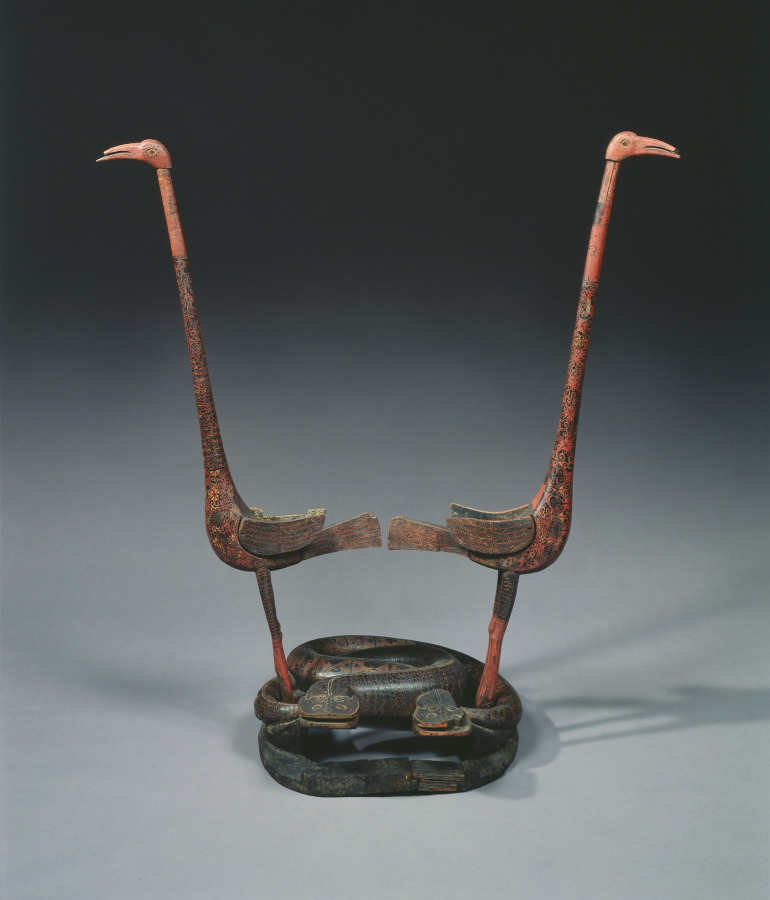
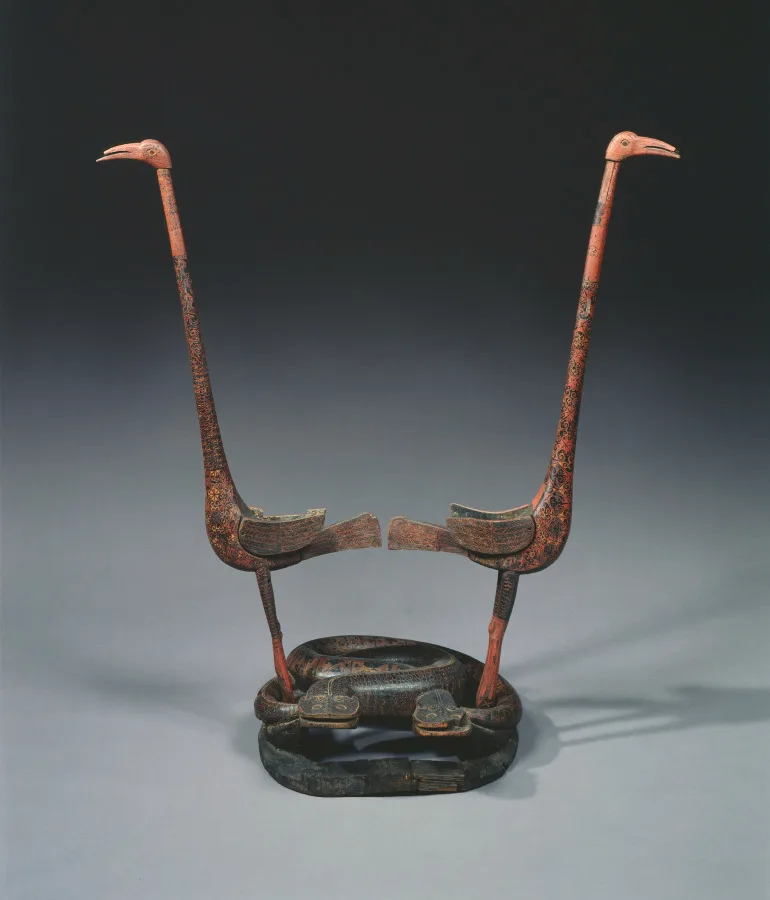
Two long-necked wooden birds face outward from a low base of intertwined serpents. Their slender necks rise high above small horizontal bodies and thin legs. Dark lacquer carries red and yellow painted patterns, with brighter red heads. The two upper bodies leave a gap between them, and the base contains several rounded snake coils.
100%

Drag to move · Pinch or +/− to zoom · Arrow keys to pan · 0 to reset

The Cleveland Museum of Art · 1938.9 · Image: CC0Museum image ↗
A little context

Two impossibly slender birds rise from intertwined snakes, leaving an open centre where a ritual sound may once have hung.

The construction seems to balance opposites. Very long, slender necks rise above a compact, heavy-looking knot of snakes. The birds’ bodies face away from one another, leaving an open space between them. Dark lacquer and coloured patterns cover both birds and serpents, giving the separate animals a shared surface rhythm.

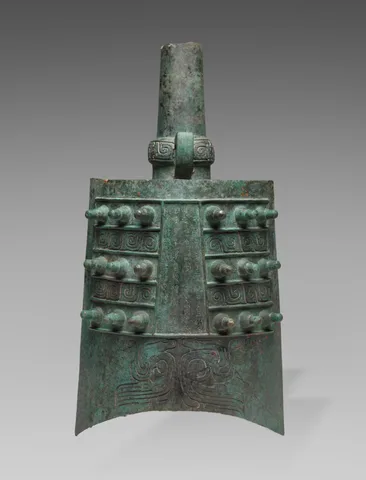
The museum describes this Chu-period object as a probable drum stand, with a lightweight drum suspended by strings through the beaks. Yet it also questions whether the delicate structure was fully practical or mainly symbolic within a tomb. That uncertainty is part of the object’s interest. We can see how the birds and coils distribute visual weight without claiming to have tested a reconstructed instrument. Scientific analysis has identified an additional blue or green pigment now discoloured, another reminder that the surviving appearance is not the complete original one. Compare the Lai Bell to distinguish a probable instrument support from the object that actually produces sound.

A careful reading

The drum-stand function is probable rather than certain, and the museum questions how practical the slender structure was. The absent drum and changed pigments limit any reconstruction of performance or original colour.
Try your eye

Which visible feature raises the museum’s question about practical use as a drum stand?

Where this reading begins

  • Cranes and Serpents — collection record — The Cleveland Museum of Art. Supports identification, dating, materials, authorship qualifications and contextual interpretation; close-looking observations describe the individually inspected museum photograph. Museum record updated 2026-11-12; accessed 2026-11-13.

Our observations describe the supplied museum photograph. Historical identifications and context follow the cited collection record; interpretive limits are stated above. This is an independent guide, not a museum endorsement.

Image rights & attribution

Cranes and Serpents (蛇座鳳鳥鼓架), 475–221 BCE. China, reportedly from Hunan province, Changsha, Warring States period (475–221 BCE), State of Chu (c. 1046–223 BCE). Lacquered wood with polychromy; overall: 132.1 x 124.5 cm (52 x 49 in.). The Cleveland Museum of Art, Purchase from the J. H. Wade Fund, 1938.9

Individual API record marked CC0; checked 2026-11-13. CC0 1.0 dedication. Record date: 2026-11-12 14:47:57.161000. Web JPEG downloaded unchanged; responsive WebP and zoom derivatives resized and recompressed; numbered annotation overlay separate from image.