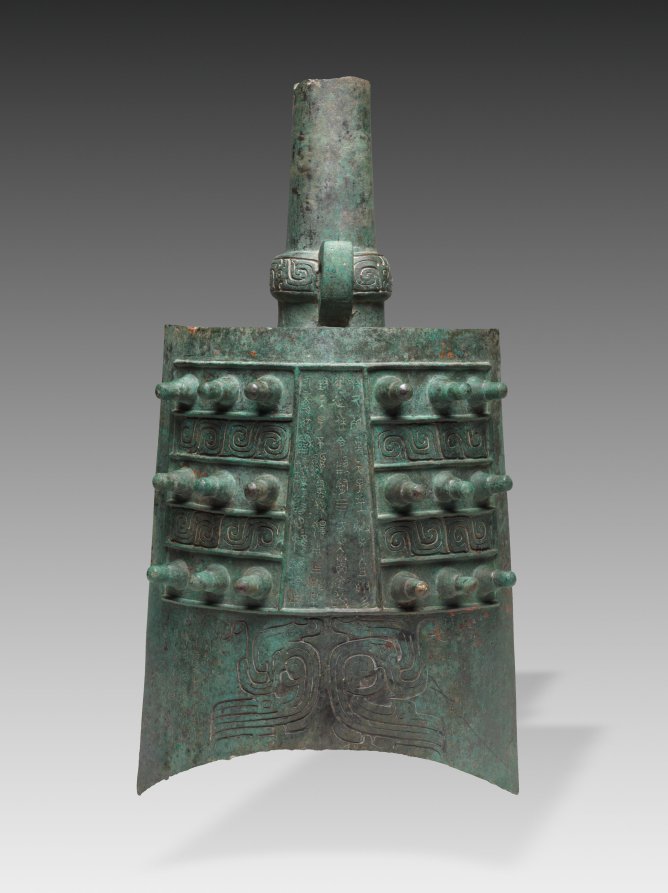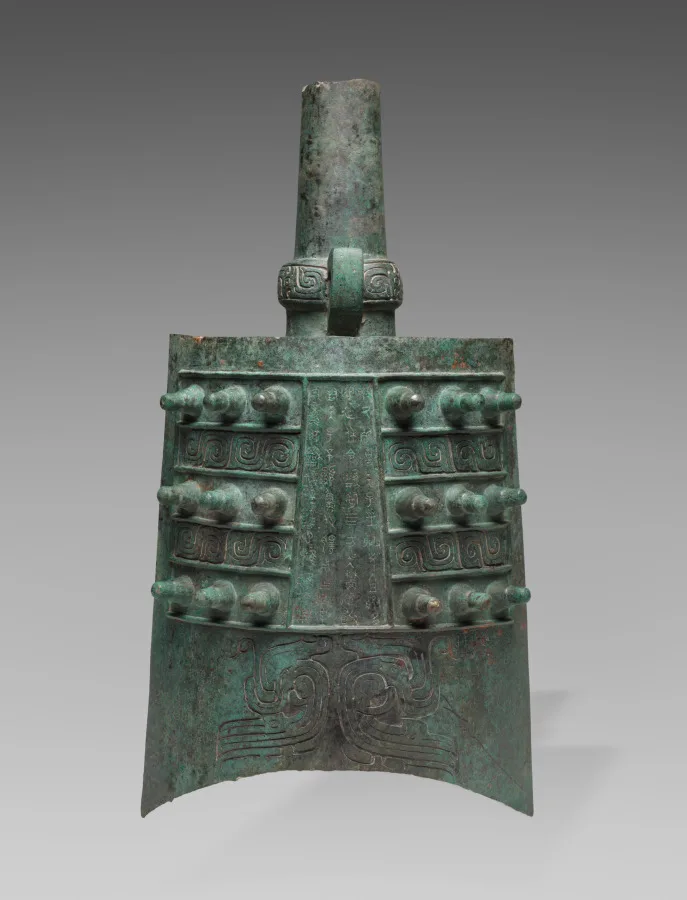
Rows of bosses frame a bronze surface that belonged to a set of bells, a family offering, and a political history.
The bell’s surface has a strong order: rows of bosses stand on either side of a central strip, with patterned bands below. Its unusual outline is not the familiar round church-bell shape. The museum explains that its lens-shaped cavity allowed two different tones, although a photograph cannot reproduce the sound or the original performance.
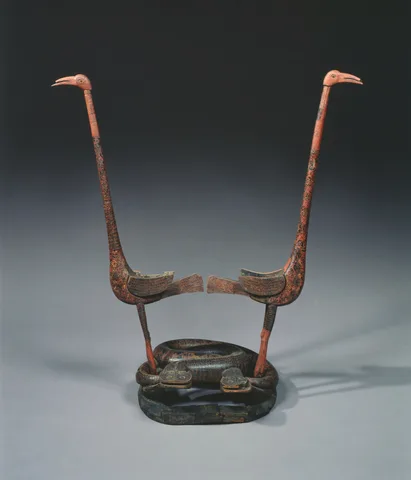
This was the second-largest bell in a set of eight commissioned by a man named Lai. An inscription records his ancestors’ service to the Western Zhou court, his own hereditary appointment, and his dedication of the bells to his father. Music, family remembrance, and political authority therefore meet in one object. The text is not fully readable in this frontal view, so that history must be traced to the museum record rather than claimed from the visible bosses alone. Compare the bell with Cranes and Serpents: both connect ritual to sound, but one is a sound-producing bronze and the other a probable support for a drum.
The inscription’s history is supplied by the museum record, not transcribed from this photograph. The two-tone capacity cannot be demonstrated by a silent image, and the original eight-bell ensemble is not shown.