Read the
Picture
An open collection
Italy, Naples · Painting

The Crucifixion of Saint Andrew

Caravaggio (Italian, 1571–1610) · 1606–7

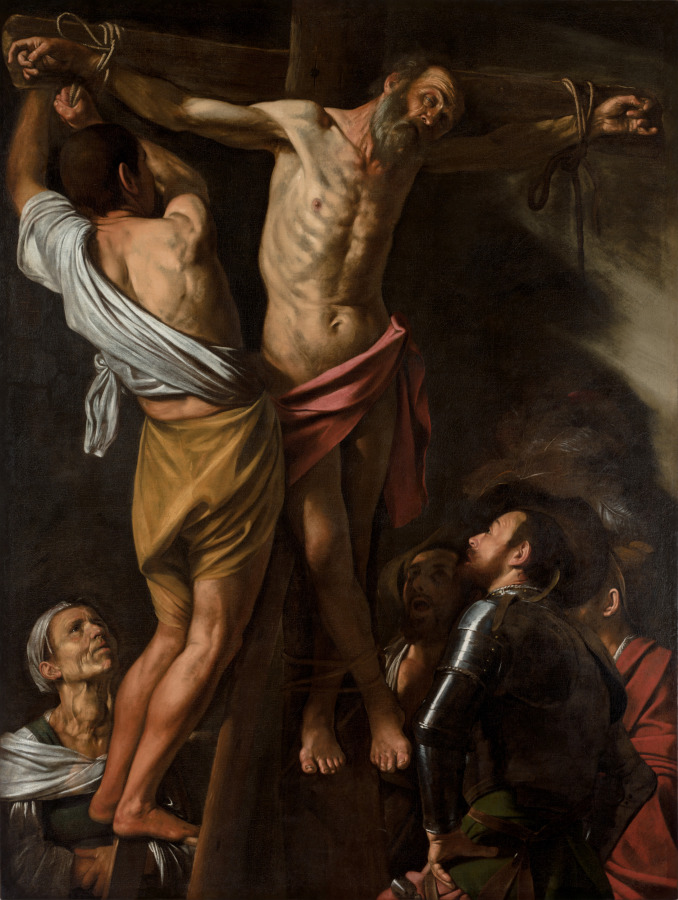
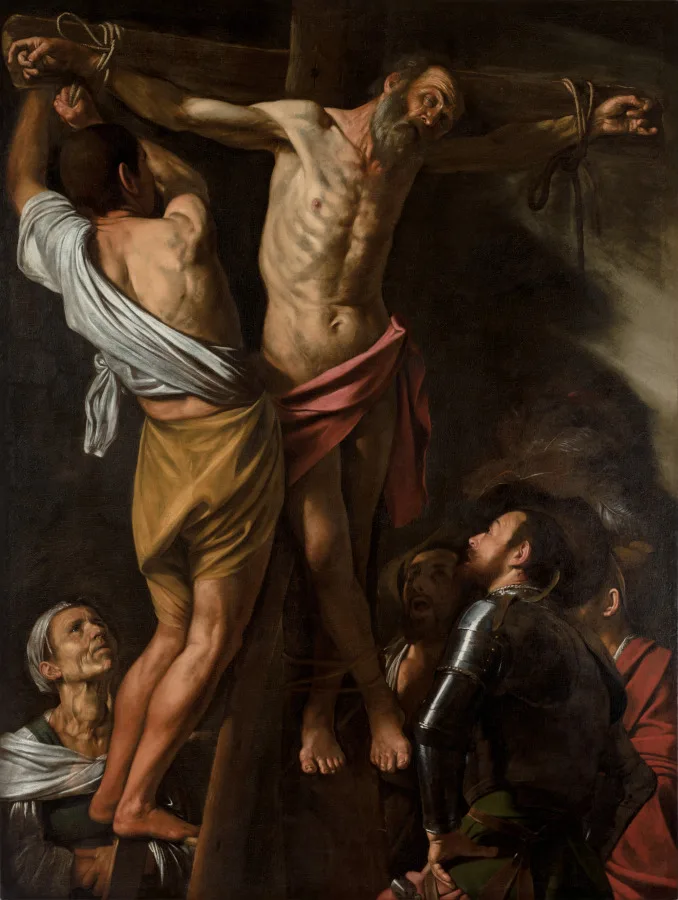
An elderly, bearded man hangs with arms extended from a wooden cross against a dark background. At left a man reaches toward a rope around his wrist. Several figures look upward from below, including a woman with a pale head covering and a man in dark armor. Strong light picks out skin and cloth.
100%

Drag to move · Pinch or +/− to zoom · Arrow keys to pan · 0 to reset

The Cleveland Museum of Art · 1976.2 · Image: CC0Museum image ↗
A little context

Follow the hands at the cross: a familiar crucifixion image turns out to show an attempted release.

A cross may make the general subject recognizable, but the action here needs more careful reading. The man on the left is reaching to the binding at Andrew’s wrist. According to the Christian martyrdom narrative explained by the museum, sympathetic witnesses had persuaded the authorities to release Andrew, but those trying to untie him were miraculously unable to do so. This is the story Caravaggio turns into an intimate encounter of bodies, hands, and looking faces.

The dark background withholds the distractions of a crowd or a large landscape. Light falls strongly on Andrew’s torso and the worker beside him, while the spectators emerge in fragments from below. For the museum, this light has a religious significance within the narrative. You can also observe its practical effect on your own attention: it establishes who matters, makes the strain of the bodies palpable, and connects the upper action with the people watching it.

A careful reading

The miraculous events belong to Christian tradition, not independently documented reportage. Andrew often has an X-shaped cross in Western art, but this painting uses a vertical cross, reminding us that attributes can vary.
Try your eye

Why is the person at Andrew’s wrist not simply identifiable as an executioner tying him up?

Where this reading begins

  • The Crucifixion of Saint Andrew — collection record — The Cleveland Museum of Art. Recounts the Christian martyrdom narrative of an attempted release, interprets the light contrast, and notes the vertical cross rather than Andrew’s usual X-shaped cross. 2026-09-22; accessed 2026-11-16.

Our observations describe the supplied museum photograph. Historical identifications and context follow the cited collection record; interpretive limits are stated above. This is an independent guide, not a museum endorsement.

Image rights & attribution

The Crucifixion of Saint Andrew, 1606–7. Caravaggio (Italian, 1571–1610). Oil on canvas; framed: 233.5 x 184 x 12 cm (91 15/16 x 72 7/16 x 4 3/4 in.); unframed: 202.5 x 152.7 cm (79 3/4 x 60 1/8 in.). The Cleveland Museum of Art, Leonard C. Hanna Jr. Fund, 1976.2

Individual API record marked CC0; checked 2026-11-13. CC0 1.0 dedication. Record date: 2026-09-22 12:35:55.083000. Web JPEG downloaded unchanged; responsive WebP and zoom derivatives resized and recompressed; numbered annotation overlay separate from image.