How stories unfold
Pictures do not always tell stories from left to right. Artists use scale, repeated forms, concentrated action and differences in setting to guide a viewer. Some scenes show one charged moment; others compress larger narratives. Begin by identifying where the action gathers, then use the documented story to test what you think you see.
Begin the journey ↓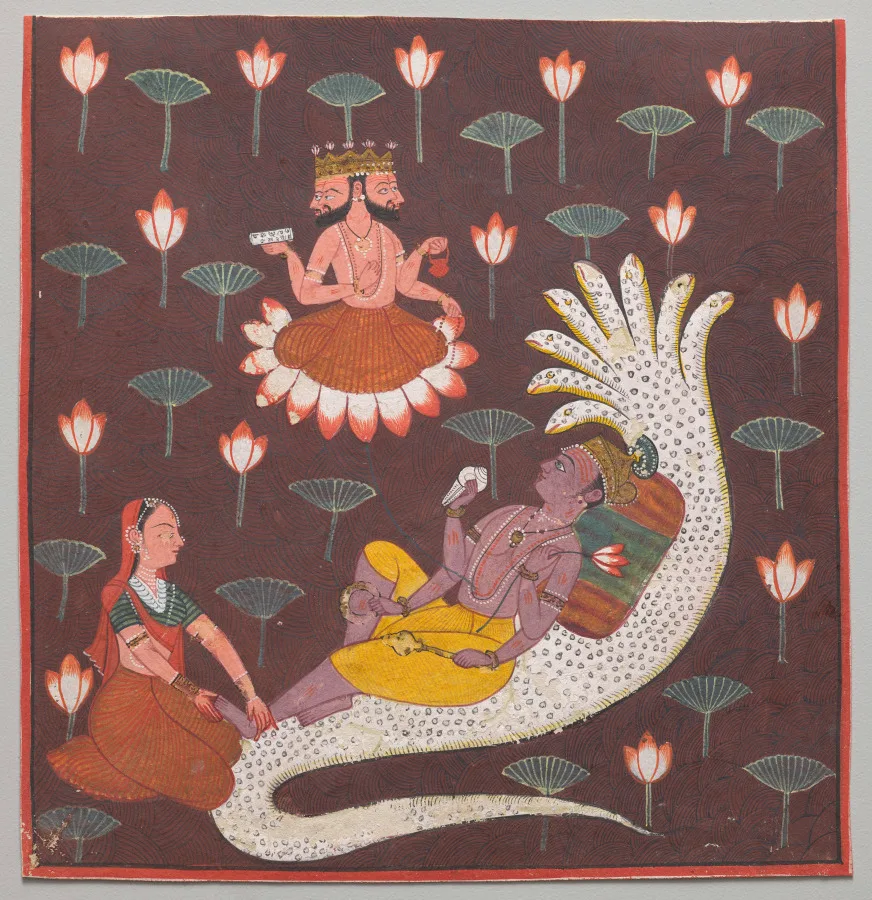
Stillness at the centre
Follow Ananta’s coiled body beneath the reclining Vishnu to the fan of serpent heads behind him. The museum places this scene before creation, when Vishnu rests on the cosmic ocean. The visibly supporting serpent helps you locate the resting figure before interpreting the smaller surrounding figures.
Carry this question: How do the serpent’s body and many heads frame the reclining figure?
Open the artwork ↗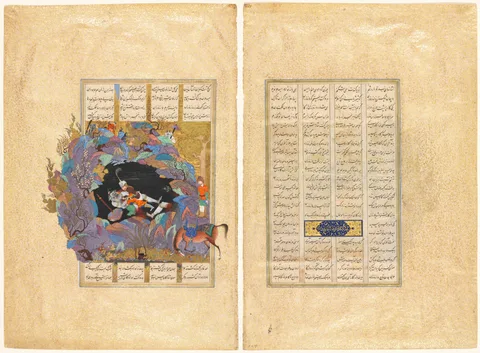
Action within a manuscript page
Find the combatants in the black cave on the illustrated left-hand leaf. The supplied photograph shows two manuscript sides, not one continuous scene. The museum identifies Rustam’s encounter with the White Div from the Shahnameh; the surrounding writing connects this violent moment to a larger literary work.
Carry this question: How does the artist make the struggle legible among surrounding details?
Open the artwork ↗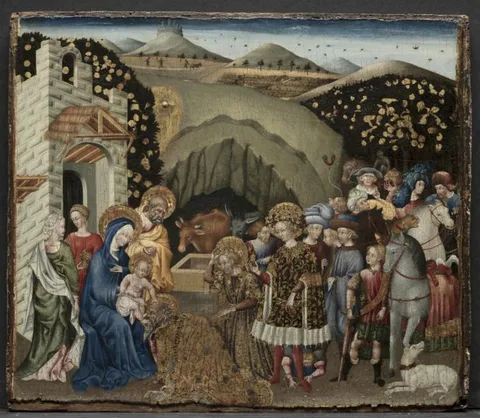
A procession becomes a meeting
Follow the groups toward the encounter at the centre of the Christian narrative. Costume, movement and differences of scale can help organise a crowded scene before every figure has been named.
Carry this question: Where does the flow of figures pause?
Open the artwork ↗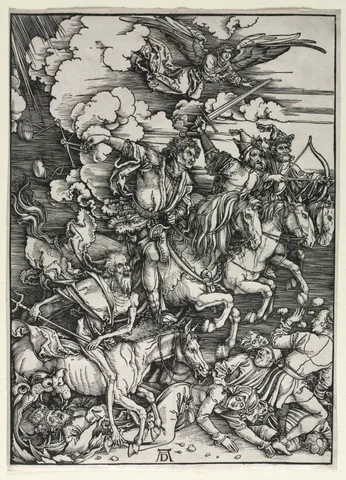
Pressure across the page
Begin with the curved bow above the mounted group, then trace its rider through the overlapping horses. Repeated diagonals and windblown forms make the group seem to advance together. Dürer compresses an episode from Revelation into this crowded woodcut; each attribute helps separate one rider from the next.
Carry this question: Which repeated directions make the riders seem to advance together?
Open the artwork ↗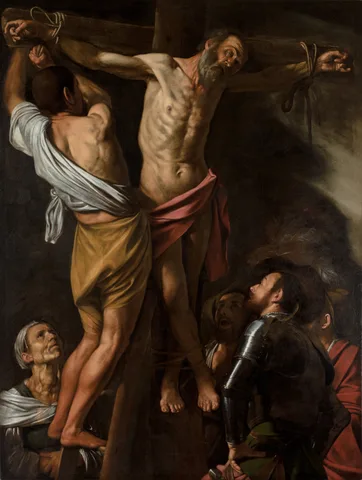
An action easy to misread
The raised hands reach toward a binding at Andrew’s wrist. The museum identifies an attempt to release him; without that account, the same position might be mistaken for fastening him to the cross. Return to the hands after reading the story and notice how context changes the action.
Carry this question: What can you see at the rope, and what does the story clarify?
Open the artwork ↗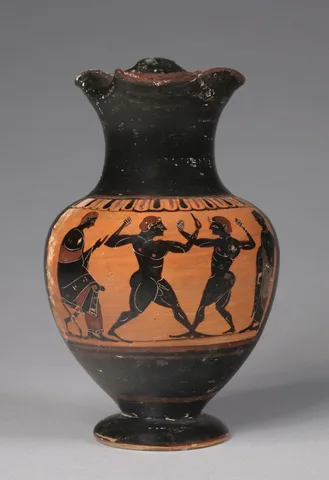
A small field of action
A vessel offers a limited curved surface for figures in motion. Compare the bodies’ spacing and gestures. The image is encountered on an object with a shape and use of its own.
Carry this question: What changes if you read the action as decoration on a jug rather than as a framed picture?
Open the artwork ↗Read with the sources
Historical context follows the individual museum records linked on each artwork page. These routes make original comparisons of visible form; resemblance alone is not evidence of shared meaning or direct influence.
- Vishnu on Ananta, the Endless Serpent — museum collection record
- Rustam's seventh course: He kills the White Div, folio 124 from a Shah-nama (Book of Kings) of Firdausi (Persian, about 934–1020) — museum collection record
- The Adoration of the Magi — museum collection record
- The Four Horsemen, from The Apocalypse — museum collection record
- The Crucifixion of Saint Andrew — museum collection record
- Black-Figure Oinochoe (Wine Jug): Boxers — museum collection record