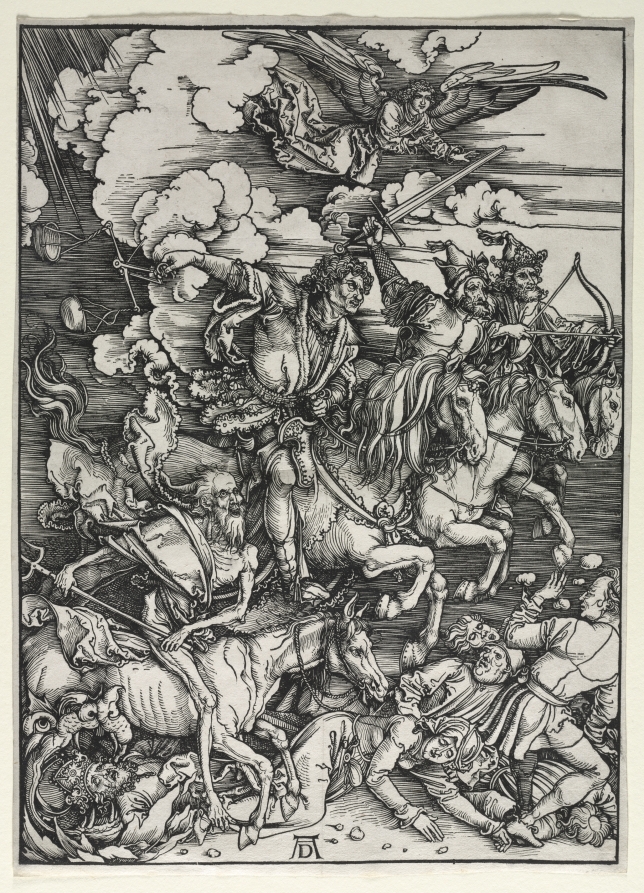
Dense lines become galloping bodies: follow the objects above the riders, then the people pressed beneath their advance.
The page seems to move in one great surge. Riders, horses, flying cloth, and horizontal lines press across the image, while people fall or recoil beneath them. Dürer made this woodcut for his illustrated Apocalypse, published in 1498 from the Christian Book of Revelation. The museum describes the project as unusually ambitious in its large images and unified design, with the artist acting as both illustrator and publisher.
There is no painted color to separate one surface from another. Instead, differences of line direction, spacing, and density distinguish bodies, clouds, fabric, and shadow. Start with an object held above the crowd, such as the bow or scales, and trace downward to its rider. Then look at the lower edge, where the forward rush becomes frighteningly close to the fallen figures. A print can be reproduced, but this does not make its individual visual decisions any less exacting: movement is engineered through the arrangement of black marks and unprinted paper.
This is a visualization of an apocalyptic religious text, not a report of an observed event. The riders’ attributes make sense within that narrative; isolated weapons or scales can mean different things in other artworks.
What gives this black-and-white image much of its sense of movement?
Practise looking at The Four Horsemen, from The Apocalypse →