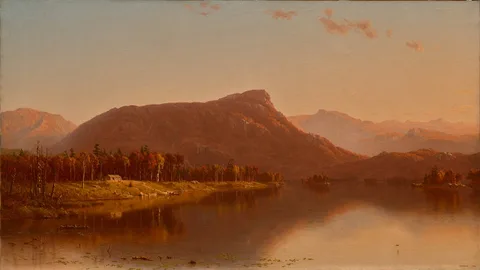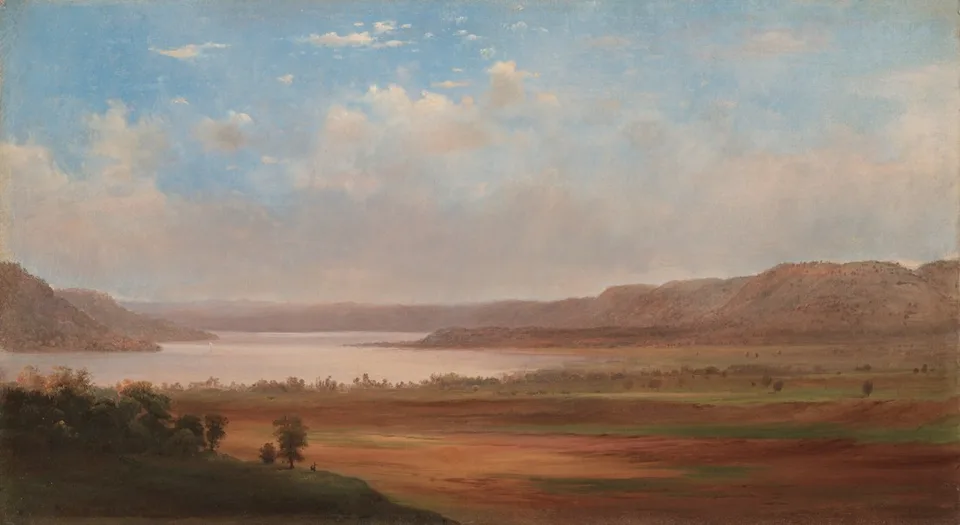
A wide pale lake opens between low hills, while warm fields in the foreground keep this expansive view connected to land under cultivation.
Robert S. Duncanson painted this Mississippi River landscape during a journey toward Canada in 1862. The museum describes him as the first African American painter to gain recognition both nationally and abroad, and suggests that he travelled to escape the Civil War’s upheaval. That motive is qualified rather than documented as a direct statement here. The painting’s calm appearance should therefore be understood alongside, rather than substituted for, its wartime circumstances.
The composition opens gradually from warm foreground fields to the pale water and softened hills beyond. A few dark trees interrupt the lower edge, giving the eye a nearby scale before it travels outward. The sky occupies much of the image and repeats the distant landscape’s muted tones. Nothing in this still scene directly pictures war or escape. Its historical setting comes from the museum record, while the visible evidence concerns breadth, tonal transition and a carefully controlled movement from cultivated land toward a more distant horizon.
The museum presents escape from Civil War upheaval as a likely motive. The calm landscape does not itself prove Duncanson’s state of mind or describe the experience of every person in the region.