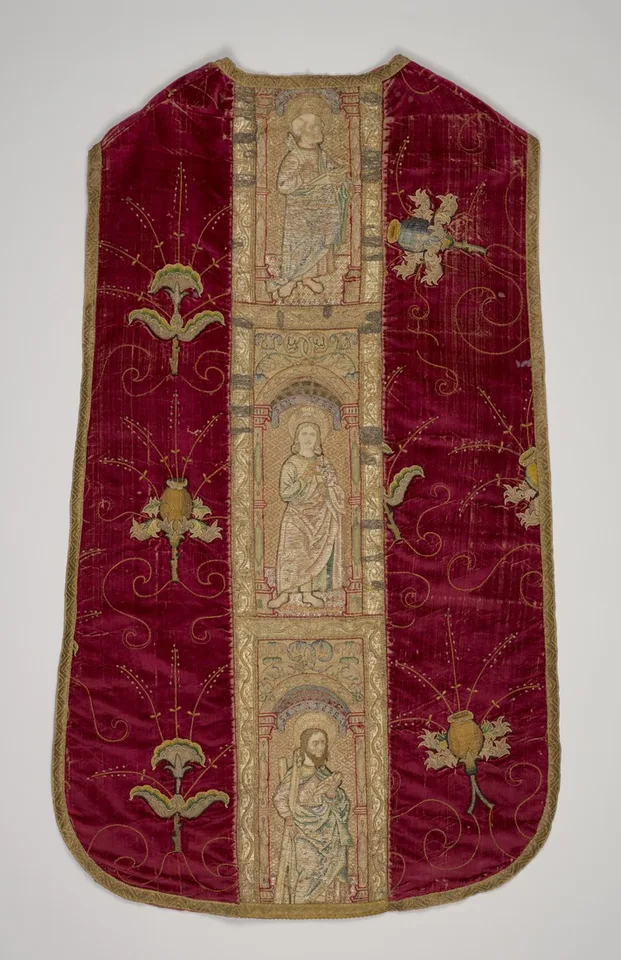
Three saints form a vertical spine while widely spaced flowers let red velvet become an active part of the design.
The central strip is densely worked, but the sides remain comparatively open. Large flowers are spaced across the red velvet, and thin curling stems occupy the gaps without covering them. This difference directs attention toward the three figures, stacked one above another under architectural frames. The garment’s shape makes the composition a surface intended for a moving body rather than a flat wall.
The museum identifies English embroidery on Florentine velvet, dating to 1500–1520. Around 1500, English makers adopted simpler isolated motifs suitable for broader production. The central band, or orphrey, shows Peter, John the Evangelist, and Andrew in that order. Gold threads were secured by silk stitches at different densities to create shading, while silk also described skin and hair. Much of that more vulnerable silk has disintegrated. The present appearance therefore combines a designed contrast between gold and velvet with uneven survival of the materials that once completed the figures.
Loss of silk thread has altered the saints’ faces and hair. The surviving photograph shows a vestment surface, but cannot recreate its full movement, liturgical setting, or original color balance.