A crown passes between two central figures in a picture whose luminous folds are made from thread rather than paint.
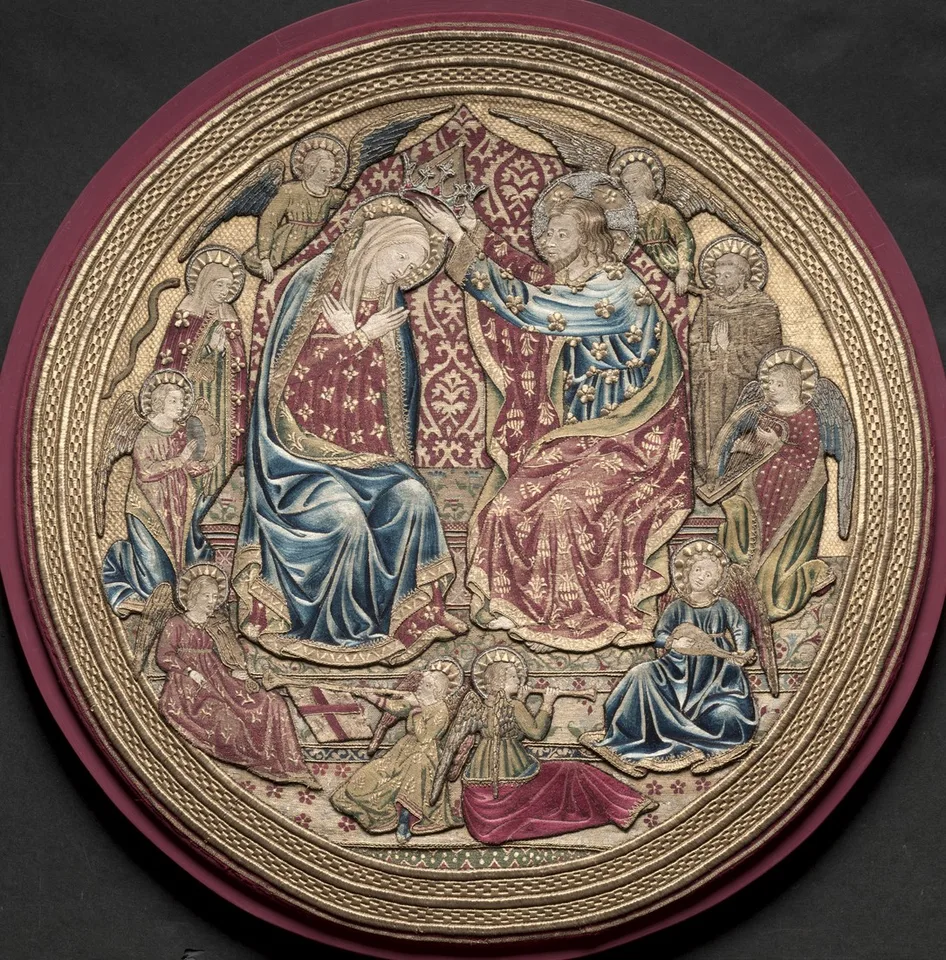
The circular format gathers the figures around a central act. Mary bows toward Christ, who raises the crown above her head, while surrounding angels turn inward. Blue drapery introduces strong folds within the otherwise gold-and-red field. Along the lower edge, musicians occupy the curve, making the round boundary part of the scene’s organization rather than an arbitrary cut.
The museum identifies this Florentine embroidery as a tondo probably once attached to an altar frontal. The Coronation of the Virgin is accompanied by eight angels and the locally esteemed Saints Verdiana and John Gualberto. Its technique, or nué, uses colored silk stitches over metal thread to create shaded gold effects. That construction could compete with painting in descriptive ambition while responding differently to light. The date, 1459, belongs to a work whose material sophistication is easy to overlook if the digital image is treated simply as a small painted panel.
The proposed altar-frontal placement is likely rather than certain. A flat photograph cannot reproduce the changing reflections of metal thread or every distinction among the surrounding sacred figures. A reused backing bears an inscription naming Margherita del Caccia and 1486, but the museum questions its reliability; the catalogue retains 1459 without a named maker.
What makes the medium especially important here?
Practise looking at Embroidered Tondo from an Altar Frontal: The Coronation of the Virgin →