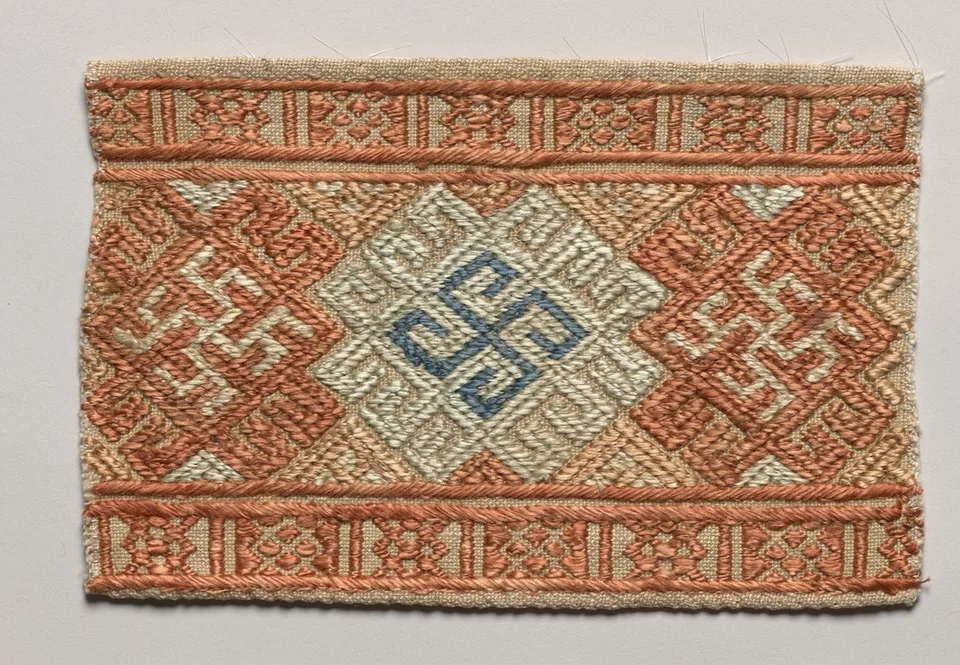
A small blue center interrupts a red-and-cream rhythm in a textile that once decorated a headdress.
The central diamond is lighter than its neighbors, allowing a compact blue motif to stand out. Rust-red stepped shapes spread to either side, while narrow bands above and below repeat smaller rosettes. The stitches give these geometric forms a physical texture that a printed pattern would not share. Loose threads at the upper edge make the surviving piece’s fragmentary condition visible.
The museum identifies the panel as embroidery from Russia’s Tambov province, used to embellish a headdress. Its broad date range, 1700–1900, should remain broad rather than being narrowed through stylistic guesswork. The record also preserves the role of collector Natalia Shabelsky and a later museum history: Cleveland acquired it in 1931, deaccessioned it in 2006, and received it back as a gift from Charla Coatoam in 2020. That return is part of the textile’s biography, alongside its original use as a decorative element worn on the body.
The record does not identify a particular wearer or give a secure meaning for each geometric motif. The fragment cannot reconstruct the complete headdress or narrow the museum’s broad date range.