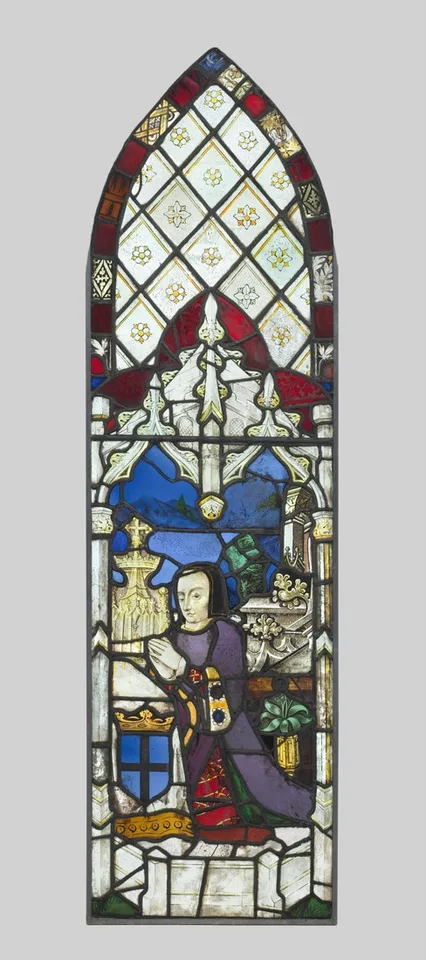
The donor’s gaze leads out of the surviving panel toward a sacred image that is no longer present.
The woman occupies only the lower portion of this tall window. Her body kneels within a rich architectural setting, while her face and joined hands turn toward the left edge. Above her, a pale lattice extends upward into the pointed top. The empty-looking height and the directed pose make the panel feel connected to something beyond its present boundaries.
The museum records this as the female half of a pair of donor panels, probably representing a married couple. Their coats of arms remain unidentified, and the original location is unknown. They likely faced a central image of the Crucifixion or the Virgin, now lost. The elaborate gown and heraldry suggest aristocratic patrons, perhaps commissioning a family chapel window, but these remain contextual possibilities rather than recovered names. The most useful starting point is the surviving direction of devotion: the figure’s gesture makes an absent center structurally important.
The donor, coat of arms, and original chapel are unidentified. The proposed central Crucifixion or Virgin is missing, so neither subject should be presented as securely recovered.