Read the
Picture
An open collection
A guided journey · 4 works

Wearing and displaying belonging

Textiles and glass can present identity through ornament, sacred figures, and signs of patronage. These four objects preserve different amounts of information about their users. A headdress fragment has a detailed collecting history but no named wearer; a vestment retains damaged saints; an embroidered tondo points toward an altar; and a donor window directs us toward a missing center.

Begin the journey ↓
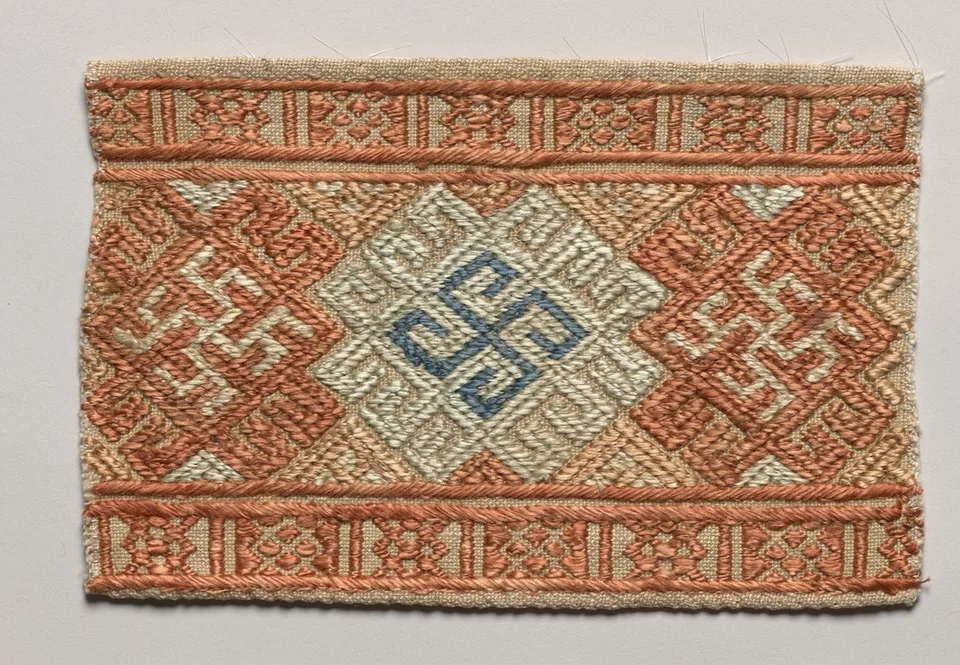
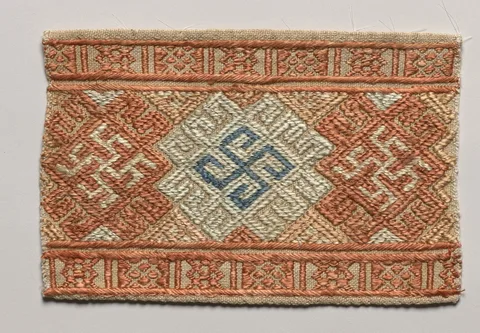
A small rectangular embroidered panel shows a cream central diamond containing a blue hooked cross-like motif, flanked by rust-red geometric forms. Narrow upper and lower bands repeat rosettes and vertical dividers. Thick stitches create a raised textured surface, and loose pale threads extend beyond the top edge of the linen ground.
01A small rectangular embroidered panel shows a cream central diamond containing a blue hooked cross-like motif, flanked by rust-red geometric forms. Narrow upper and lower bands repeat rosettes and vertical dividers. Thick stitches create a raised textured surface, and loose pale threads extend beyond the top edge of the linen ground.
Panel for a Headdress · 1700–1900

The unfinished-looking upper edge

The fragment’s exposed threads prevent it from standing for a complete headdress. Its documented museum departure and return are more secure than the identity of its original wearer.

Carry this question: What would you need to reconstruct the complete headwear?

Open the artwork ↗
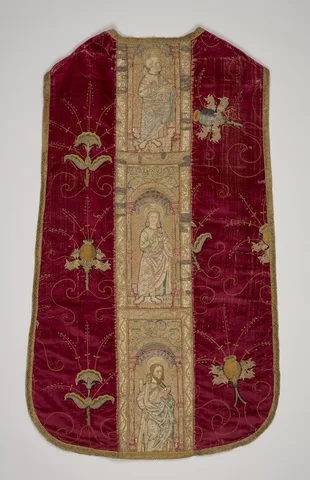
02A deep red ecclesiastical garment has a long rounded lower edge and sloping shoulders. A broad gold-toned embroidered strip runs down the center, showing three standing saints in architectural compartments. Large isolated floral motifs scatter across the velvet on either side. Much of the figures’ faces and hands is pale or worn.
Chasuble with Orphrey Band · 1500–1520

Worn face within gold work

Losses in silk alter faces within otherwise legible gold embroidery. Material survival changes how the sacred figures appear, so present simplicity is not always an original design choice.

Carry this question: Which parts seem to have survived differently from their neighbors?

Open the artwork ↗
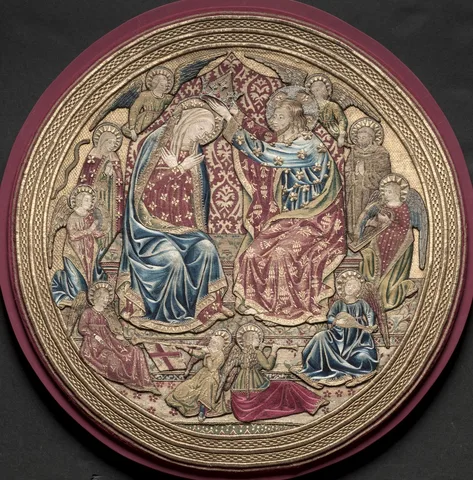
03A round embroidered panel shows a seated woman bowing as a crowned male figure reaches to crown her. Angels and other haloed figures surround the pair, several playing instruments near the lower edge. Blue, red, cream, and gold threads create patterned garments and a rich background. Concentric braided-looking borders enclose the circular scene.
Embroidered Tondo from an Altar Frontal: The Coronation of the Virgin · 1459

Blue folds made in thread

Thread builds folds that can initially resemble paint. The likely altar-frontal setting gives the circular scene a liturgical context, while reflected metal light remains difficult to reproduce digitally.

Carry this question: What does embroidery add that a flat photograph conceals?

Open the artwork ↗
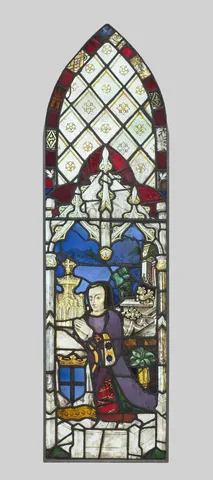
04A tall pointed stained-glass panel shows a kneeling woman in a purple, red, and gold dress near the bottom. Her joined hands and face turn left toward the edge. A shield appears beside her, beneath an ornate canopy. Above, a pale diamond lattice with small yellow motifs rises to the pointed top within a red border.
Stained Glass Panel with Female Donor · c. 1480

Hands directed left

The kneeling woman’s hands and face lead toward a lost sacred scene. Her rich dress and shield establish elite display more securely than a personal name.

Carry this question: How does her pose make absence part of the composition?

Open the artwork ↗
Take this with you

Keep original use, surviving material, and later collecting history separate when an object’s personal identities remain unknown.

Try an exercise with the first work →

Find another journey →

Read with the sources

Historical context follows the individual museum records linked on each artwork page. These routes make original comparisons of visible form; resemblance alone is not evidence of shared meaning or direct influence.