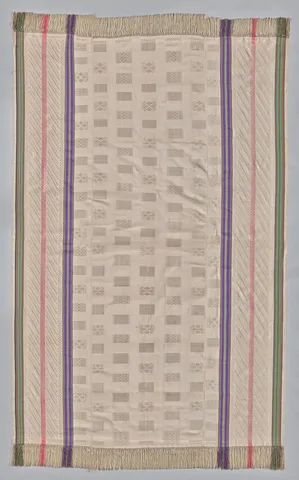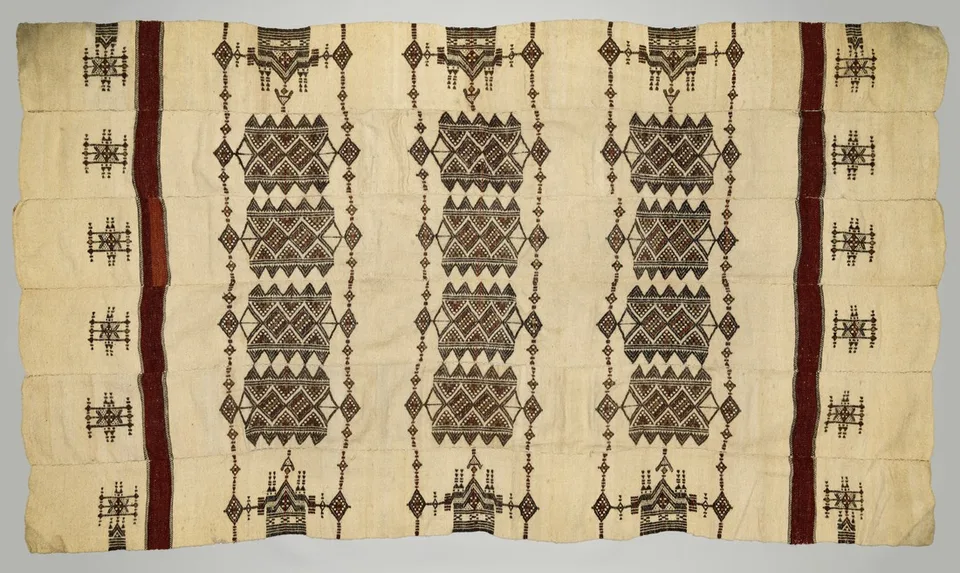
Six joined strips make a broad wool field, but the repeated dark patterns persuade the eye to read long vertical columns.
This kaasa blanket or cover was woven in six strips and sewn together along their long edges. The museum attributes it to Fulani-style weaving in Mali, Niger or Burkina Faso, retaining a broad geographic range. Additional coloured weft threads float across a cream wool ground to create the motifs. Its dark browns, blacks and reds therefore arise from the structure of weaving, rather than paint applied to a finished white cloth.
Try following one central column from top to bottom. Diamonds and pointed shapes repeat within borders that narrow between larger blocks. Then turn your attention across the cloth: faint horizontal joins cut through the strongly vertical design. The assembled object asks two different kinds of line to coexist. The museum notes that some named motifs connect with Islam or neighbouring Tuareg cultures, but does not identify each shape in this particular view. A visual pattern can be described precisely even when its specific name remains unavailable.
The record offers several possible countries and does not decode every motif. Avoid assigning a single religious meaning to all the repeated diamonds or treating the blanket as a national emblem.