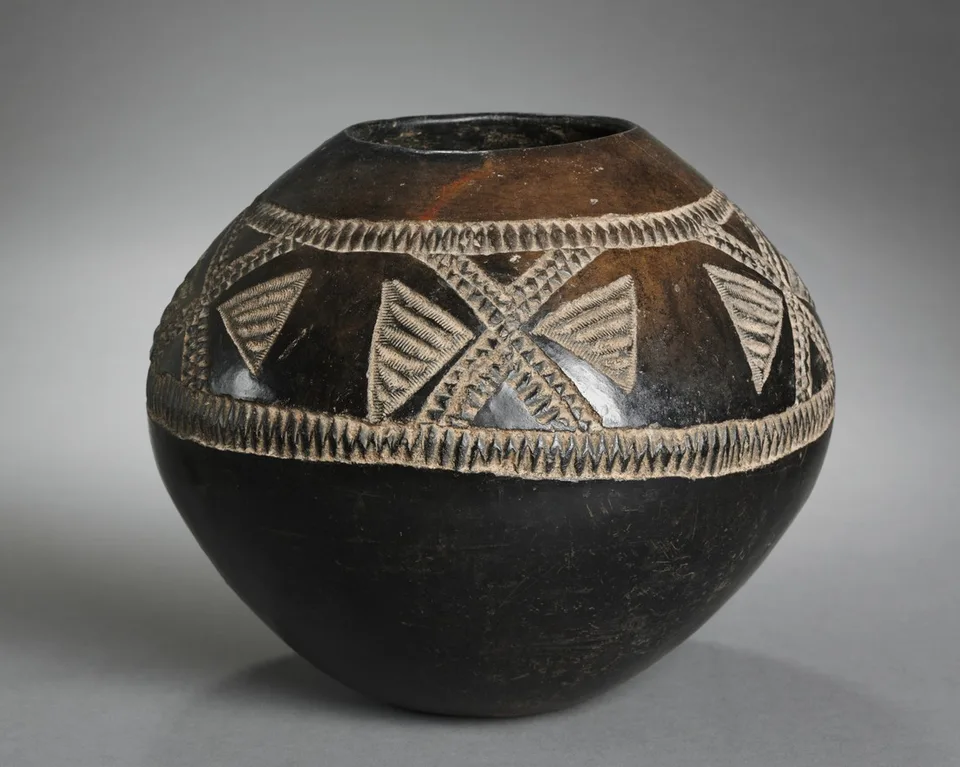
A broad patterned belt breaks the dark sheen of a round pot, revealing how surface treatment can organize a swelling form.
The museum places this pot within Zulu women’s pottery making. It describes a process beginning with careful selection of clay, followed by coiling, smoothing with flattened stones and firing in an earthen pit. Palm leaves helped blacken the fired surface, and long use could deepen its sheen. The smooth dark areas are thus part of a sequence of material choices and handling rather than simply the absence of decoration.
The decorative belt occupies the broad shoulder, where the vessel begins to turn inward toward its mouth. Fan-shaped triangles alternate with crossing diagonals, bounded above and below by closely repeated cuts. Compare these pale, rough-looking marks with the unbroken lower belly. Their different response to light makes the pot’s roundness more emphatic. Although the record describes beer-pot traditions, the photograph alone cannot recover a particular gathering, owner or recipe. It does show how a potter balanced a usable opening with an expansive decorated body.
The museum describes a wider pottery tradition rather than this vessel’s individual history. Neither its precise contents nor the identity of its woman maker is recorded.