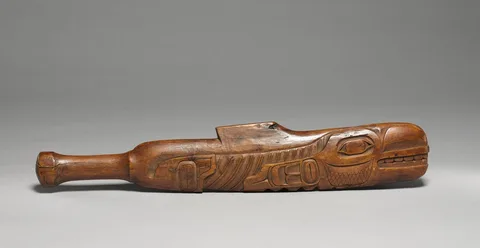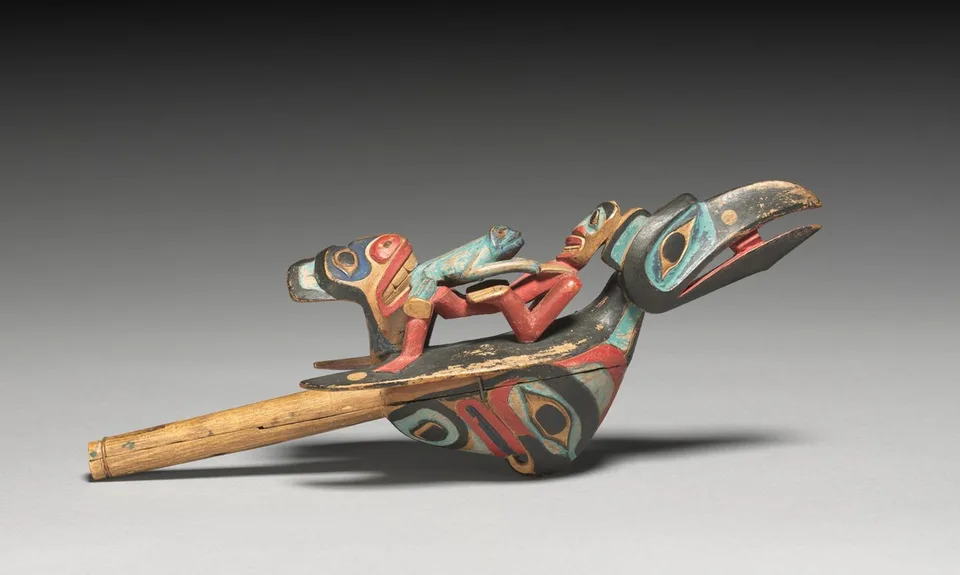
A raven carries another small scene on its back, making this painted rattle an image that must be followed from handle to beak.
Raven rattles belong to Northwest Coast traditions in which figures on a bird’s back can refer to encounters between humans and other-than-human beings. The museum cautiously connects such imagery with shamans’ exceptional abilities, while noting that secular chiefs also used raven rattles during winter ceremonies. This Haida example therefore should not be assigned automatically to one named practitioner or a single exclusive function.
The object’s structure encourages a sequence of looking. Begin at the long handle, follow it into the rounded bird body, then trace the upward turn to the open beak. A second group of smaller forms occupies the back, creating a compact scene above the main animal. Painted ovals and curved borders reinforce the carved contours. As a rattle it also produced sound through handling, an aspect absent from the still image. The museum records its arrival through exchange with the American Museum of Natural History, but does not supply an individual performance history.
The museum uses qualified language about the figures and their connection with shamanic acts. A still photograph cannot establish a particular performance, owner or sound.