Carried images and emblems
The images on portable objects can change with movement and use. A rattle is held, a club is gripped, a bag is carried and an ornament is attached to something else. This route follows those relationships without inventing a performance or wearer. It also asks how much of an object’s larger arrangement is missing from a museum photograph.
Begin the journey ↓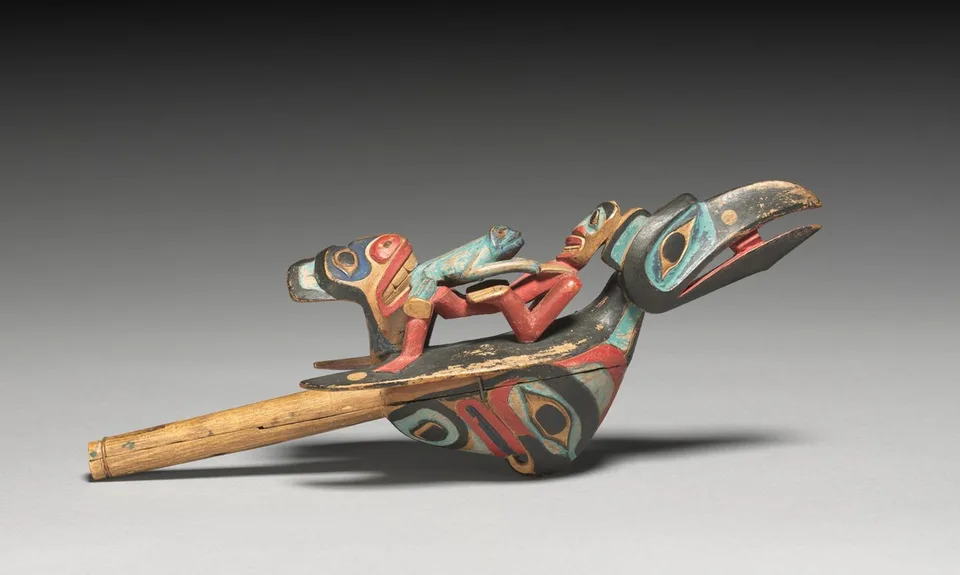
A beak within a larger performance
The raven’s open beak establishes the main animal form, while another scene occupies its back. A still photograph preserves this arrangement but cannot recover the rattle’s sound, a particular owner or a specific performance.
Carry this question: How does the beak direct attention along the rattle?
Open the artwork ↗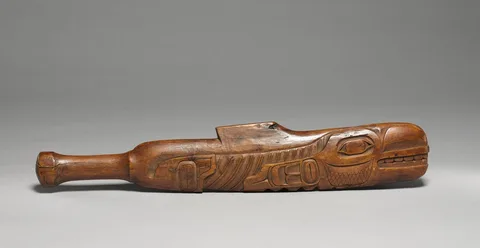
A hunter on a hunting tool
The heavy end becomes an animal head that the museum tentatively identifies as a sea lion. The relationship with a skilled marine hunter is suggestive, but the precise identity and history of use remain qualified.
Carry this question: How is the heavy end distinguished from the grip?
Open the artwork ↗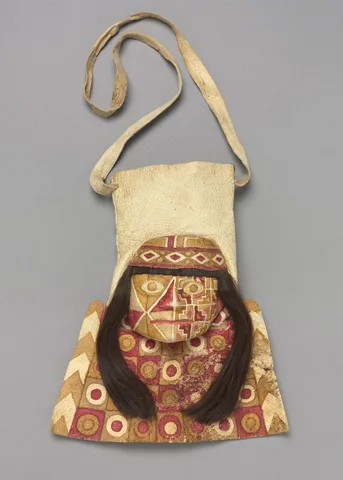
A face on something carried
The divided facial design combines contrasting geometric areas. The museum compares it with Wari warrior imagery, while the real hair and carrying function make the bag more materially complicated than a flat painted portrait.
Carry this question: How do the two sides of the face differ?
Open the artwork ↗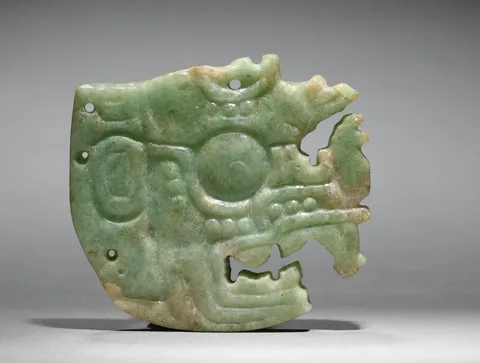
An image awaiting its crown
The circular eye dominates a profile designed for attachment to a crown. The missing larger structure limits reconstruction, and the museum identifies a royal deity generally without supplying a certain name.
Carry this question: Which features seem designed to be read from the side?
Open the artwork ↗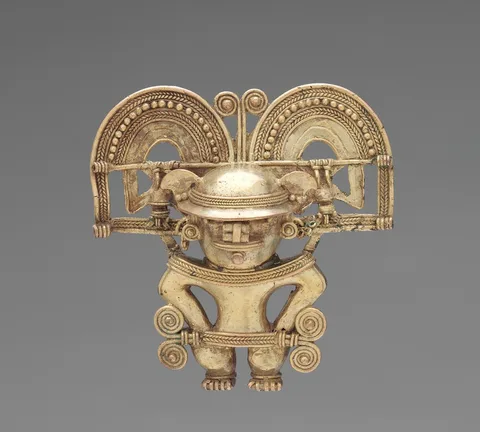
An expansive headdress at a small scale
The broad arch expands the pendant’s silhouette above a much smaller body. Lost-wax casting permits intricate openwork, but neither the elaborate headdress nor the traditional “chieftain” label securely identifies the figure’s role.
Carry this question: What is the largest shape, and what rewards closer inspection?
Open the artwork ↗Look at a pair more closely
- Gold, seams and openwork
An Inka llama and a Tairona pendant reveal different demands on precious metal.
Read with the sources
Historical context follows the individual museum records linked on each artwork page. These routes make original comparisons of visible form; resemblance alone is not evidence of shared meaning or direct influence.