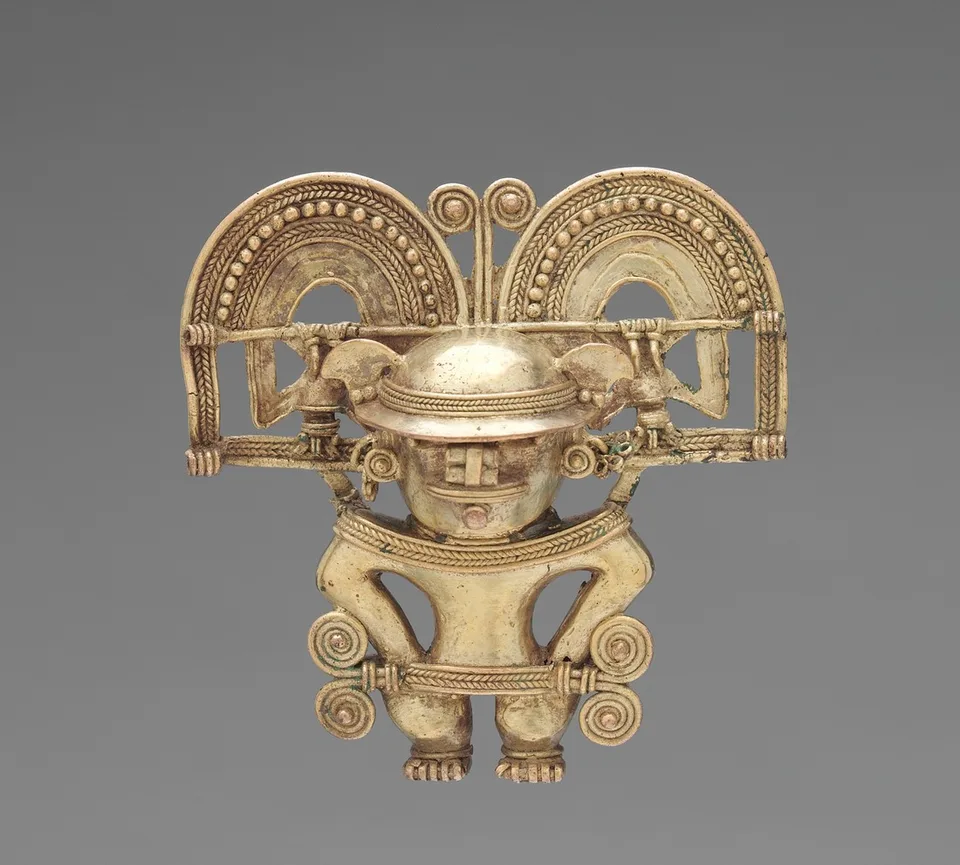
Two broad arches dwarf a small gold figure, while tiny suspended bats make the headdress more complicated than a simple crown.
Lost-wax casting allowed Tairona goldsmiths to create richly detailed pendants with fine openwork. This figure combines an enlarged headdress, a lower-lip ornament and two upside-down bats. The museum notes that such figures have often been called caciques, or chiefs, but their meaning is not securely understood. The name should therefore not turn this particular pendant into a confidently identified portrait of a ruler.
The maker uses several scales of detail at once. Broad arches establish the dominant outline, while rows of tiny rounded forms and twisted-looking borders enrich their edges. Beneath them, the compact body has bent limbs and curling ornaments around the waist. The bats hang within the upper structure, so recognizing them requires looking past the symmetry of the headdress as a whole. The pendant’s fine openings demonstrate technical control, but technical brilliance does not automatically supply a translation of its imagery. Its human and animal forms remain more specific than its uncertain social identity.
The traditional label “chieftain” is not a secure identification. The museum recognizes the lip ornament and bats but emphasizes that the meaning of such figures remains poorly understood.