Read the
Picture
An open collection
Andes, Wari, Middle Horizon, 6th-10th century · Textile

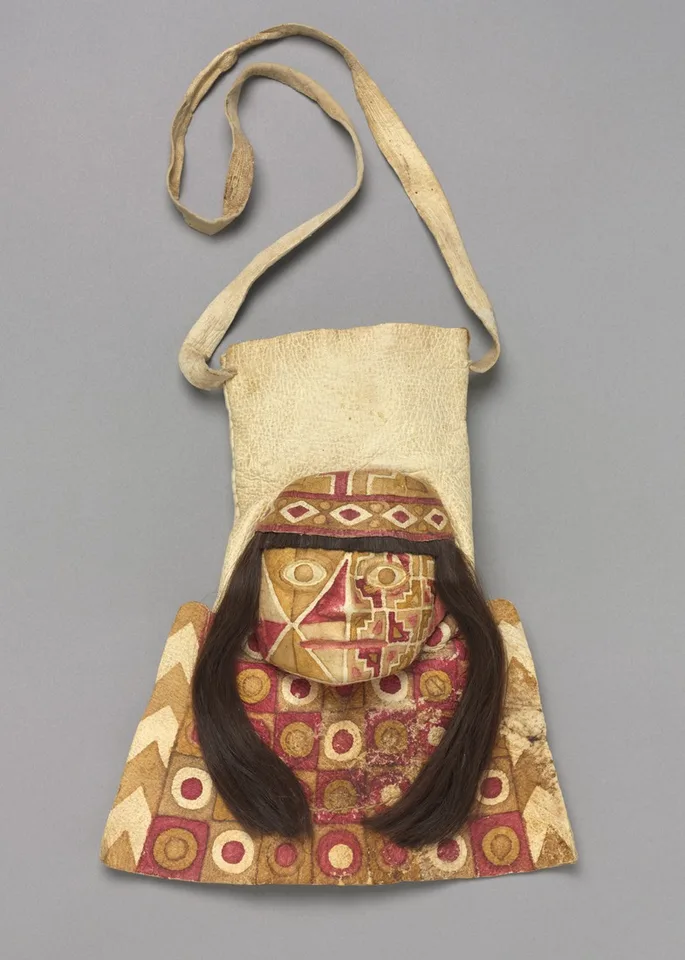
Bag with Human Face

Maker unrecorded · 600–1000

A pale elongated bag with a long loop strap carries a modeled human face on its front. Geometric red, cream and yellow designs divide the face asymmetrically. Long dark hair falls on both sides. Below it, a flaring panel is patterned with circles and bordered by pale zigzags against a reddish ground.
100%

Drag to move · Pinch or +/− to zoom · Arrow keys to pan · 0 to reset

The Cleveland Museum of Art · 2011.35 · Image: CC0Museum image ↗
A little context

A painted face and real strands of hair turn a carrying bag into a bodily image, with patterned panels suggesting dress below.

This Wari bag carried coca leaves, and the museum records leaves among its contents. Its materials include camelid hide, cotton, pigment and human hair. The front does more than display a face: real strands descend beside a modeled head, while the patterned panel below suggests a dressed body. The museum compares the facial designs with those on Wari warrior representations and proposes that the circles beneath may refer to an elite tie-dyed tunic.

The face is divided into different geometric zones rather than painted symmetrically. One eye sits within a pale shape while the other is surrounded by a denser arrangement of bars and angles. The dark hair supplies a striking material contrast with the pale bag and painted surface. Above, the plain opening and long strap keep the carrying function evident. Coca leaves have practical and religious histories in the Andes, but the preserved contents do not identify this bag’s individual owner or establish the precise circumstances of its use.

A careful reading

The elite-tunic connection is proposed, and the owner is unknown. Human hair is a documented material, but the photograph and record do not identify whose hair it was or how it was obtained.
Try your eye

Which feature introduces the texture of actual strands beside the painted face?

Where this reading begins

  • Bag with Human Face: collection record — The Cleveland Museum of Art. Identification, qualified cultural and maker attribution, materials, object-specific historical context, provenance and stated uncertainties; photograph independently inspected for visual observations. Museum record updated 2026-09-15; accessed 2026-11-14.

Our observations describe the supplied museum photograph. Historical identifications and context follow the cited collection record; interpretive limits are stated above. This is an independent guide, not a museum endorsement.

Image rights & attribution

Bag with Human Face, 600–1000. Andes, Wari, Middle Horizon, 6th-10th century. Alpaca or llama hide, human hair, pigment, cotton; coca leaf contents; overall: 26.7 x 23.2 cm (10 1/2 x 9 1/8 in.); bag: 26 cm (10 1/4 in.). The Cleveland Museum of Art, Leonard C. Hanna Jr. Fund, 2011.35

Individual API record marked CC0; checked 2026-11-14. CC0 1.0 dedication. Record date: 2026-09-15 17:30:41.262000. Museum print JPEG preserved unchanged in local originals; overview JPEG resized and recompressed from that same full frame; responsive WebP and zoom derivatives resized and recompressed; numbered annotation overlay separate from image.