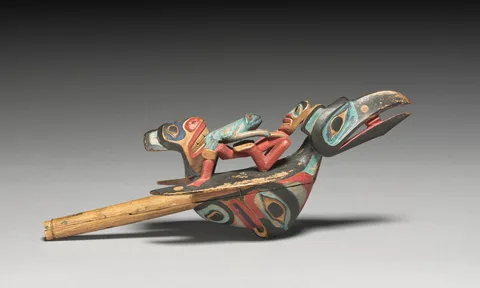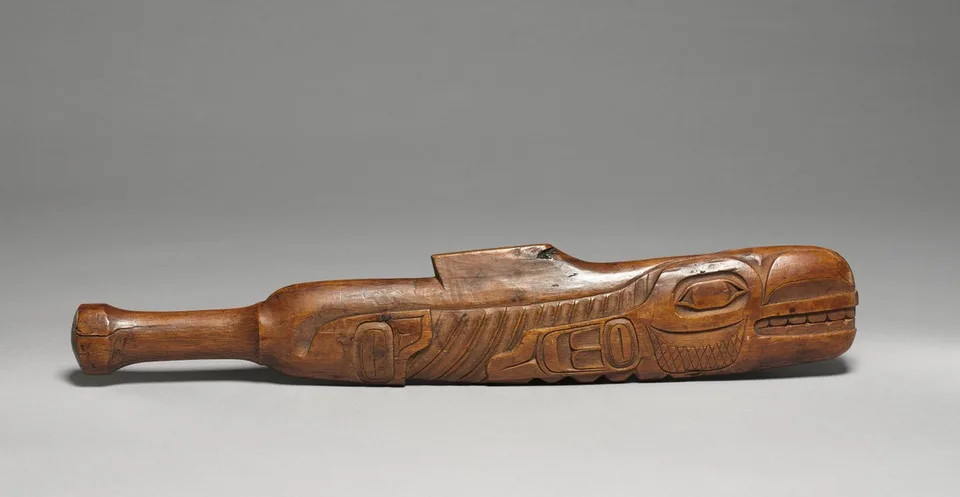
A broad animal head forms the heavy end of a wooden club, connecting a fishing tool with the image of another skilled hunter.
The museum identifies this as a Tlingit fish or seal club and proposes that its animal form represents a sea lion. Large fish could endanger a canoe by thrashing, so a club helped bring them aboard safely. The museum describes a practice of thanking the fish for surrendering its life before striking it. That context places the tool within relationships of subsistence and respect, rather than treating it as an unexplained weapon.
The form moves from a narrow handle to a heavy carved head. Its eye, mouth and sweeping body lines make the possible sea lion recognizable without removing the mass needed for the club’s use. The dark wood has a smoother sheen on broad surfaces, while incised outlines collect shadow. The museum’s animal identification remains tentative. The shared idea of a capable marine hunter is suggestive, but the photograph cannot establish the maker’s personal intention or reconstruct a particular fishing event. It preserves the union of a practical weight distribution and an animal image.
The sea-lion identification is tentative, and no named maker or fishing event is recorded. The photographed object alone cannot establish how frequently or in what exact circumstances it was used.