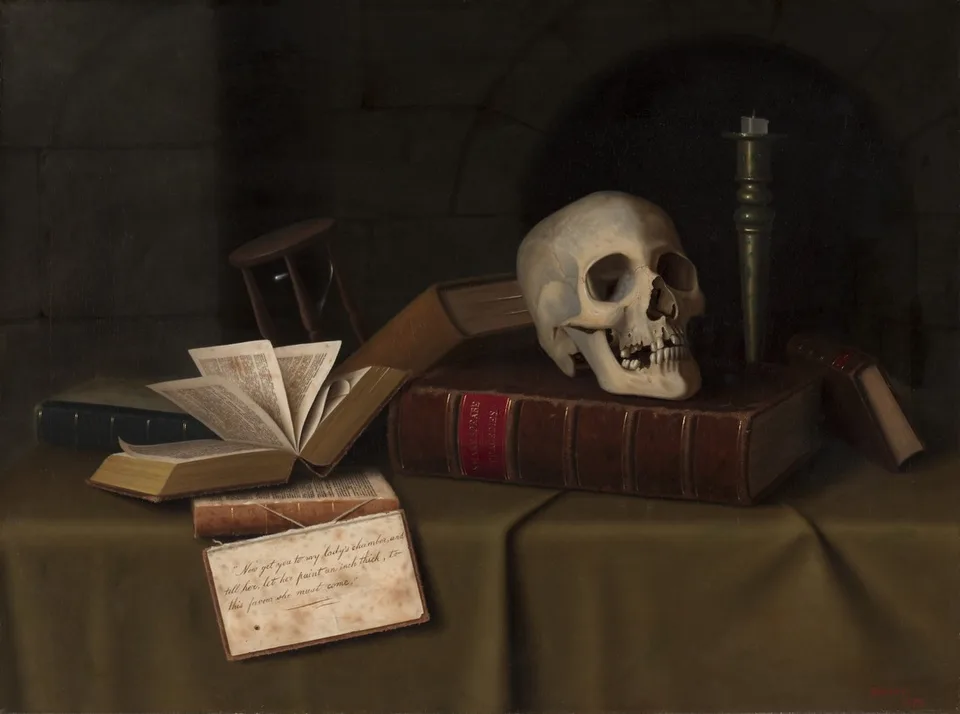
A skull rests on a heavy book beside an extinguished candle, while a painted quotation turns the still life into a meditation on its own illusion.
William Michael Harnett’s still life belongs to the tradition of memento mori, images that invite reflection on mortality. The museum identifies the skull, spent hourglass and extinguished candle as signs of death and elapsed time. A quotation from Hamlet appears on a worn book cover at the front. Its reference to paint concerns cosmetic appearance within the play while also inviting a connection with Harnett’s own painted illusion.
The arrangement is built from contrasts of texture and direction. The skull’s pale curved bone rises above a dark rectangular book; open pages make sharp light triangles on the left; the candle stands as a narrow vertical behind them. The projecting text-bearing cover seems to cross the table’s edge toward us. These objects are not simply listed symbols. Their different surfaces give the eye reasons to move between reading, recognizing and noticing the skill of representation. The theme of mortality thus shares space with an awareness that the apparently tangible things are made of paint.
The objects belong to a composed symbolic still life, not a documented room or death scene. The quotation’s link to painting is an interpretive wordplay rather than a literal depicted event.