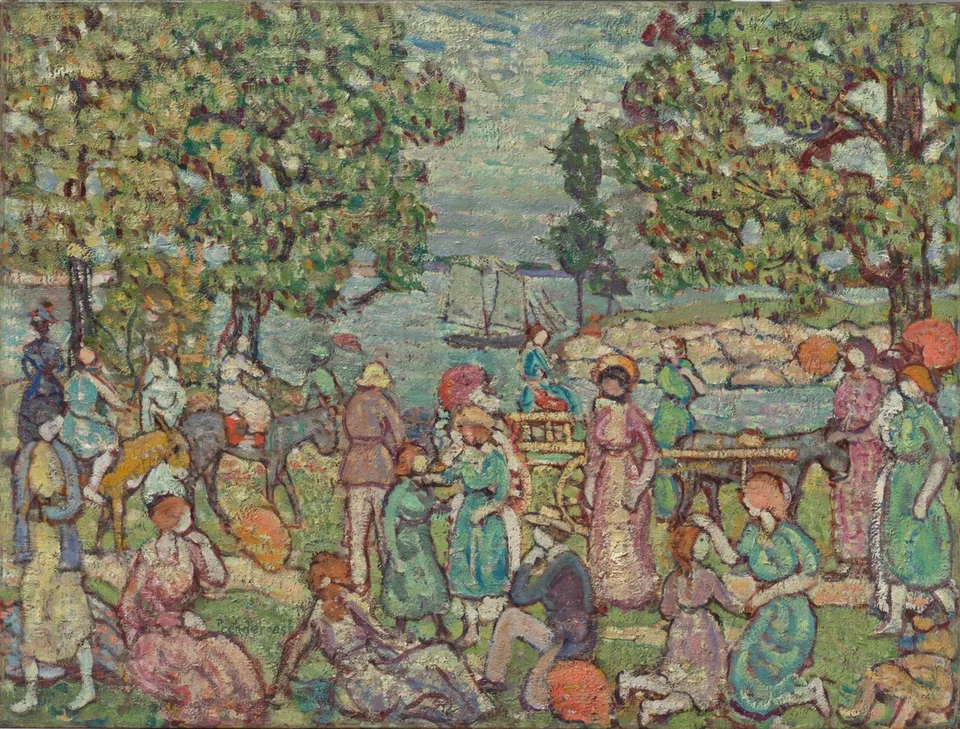
Beachgoers, leaves and water become neighbouring patches of colour, making the whole scene feel woven before any individual figure comes into focus.
Maurice Prendergast developed a style built from rounded patches of thickly applied colour. The museum compares the visual effect of this beach scene with a densely woven tapestry. That comparison concerns how the painted surface works: figures, foliage, water and boats share a closely packed rhythm of coloured units. The scene remains recognizable, but no single smoothly modeled body controls the composition.
Look at a green dress in the middle foreground, then move upward to the leaves. Both are constructed from broken touches of colour rather than continuous descriptive shading. Dark lines sometimes hold a figure together, while gaps allow neighbouring colours to mingle. The distant boats and horizontal railing offer a small amount of spatial order within the crowded field. The result invites looking both into the scene and across the surface. Its sociable setting is evident, but the museum does not identify individual people or a specific event, so their stories should remain unassigned.
The record does not identify the beachgoers or a particular occasion. The tapestry comparison describes a visual effect; the work remains oil paint on canvas, not an actual woven textile.