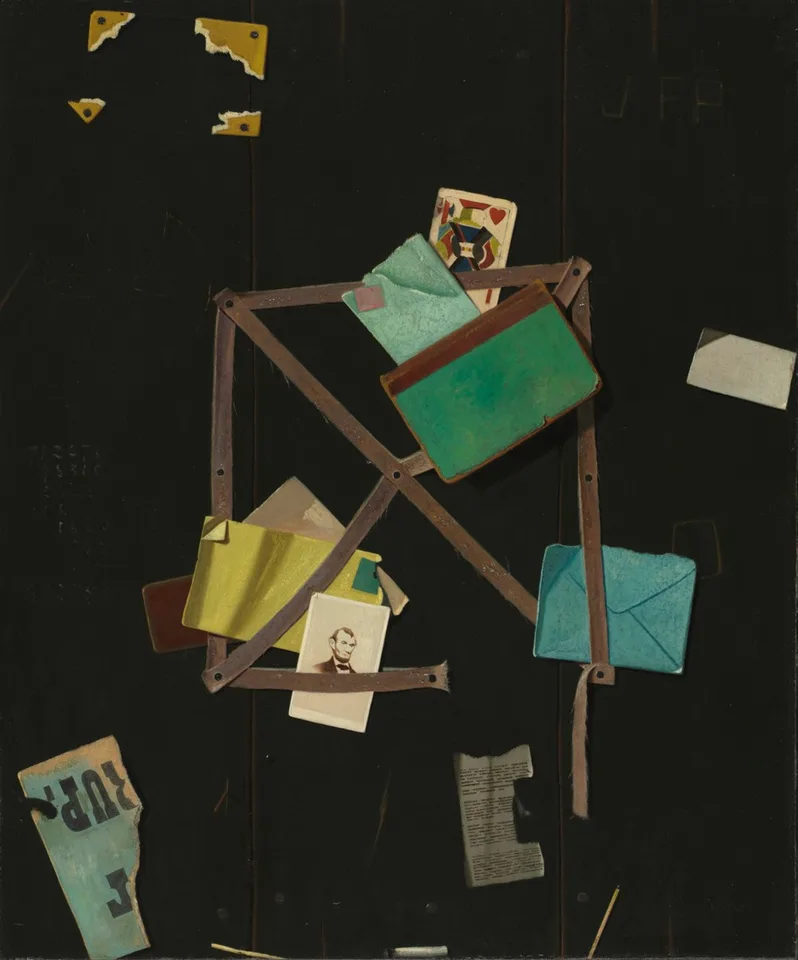
A jack of hearts peeks above crossed straps, while worn papers and a tiny cigarette butt make a painted surface seem almost touchable.
John F. Peto painted card racks as arrangements of ordinary papers and personal remnants. Such racks collected clippings, letters and other small items in one place. The museum leaves the objects’ specific symbolic meaning uncertain, while noting how their worn edges suggest recollection and the passage of time. The painting is therefore best approached through its exact material illusions before assigning a hidden biography to every scrap.
The crossed straps establish a shallow framework in front of the dark boards. Papers overlap them at different angles, with folded corners and small shadows suggesting thickness. A jack of hearts appears near the top, while a photographic face creates another kind of image within the painting. At the lower edge, the cigarette butt seems ready to leave the picture’s plane. These effects encourage a momentary mistake between painted representation and actual objects, then reward the recognition that all the apparent materials are made with oil paint on canvas.
The museum does not establish a symbolic meaning for each paper or identify every depicted item. Worn surfaces suggest memory, but do not prove a specific personal narrative.