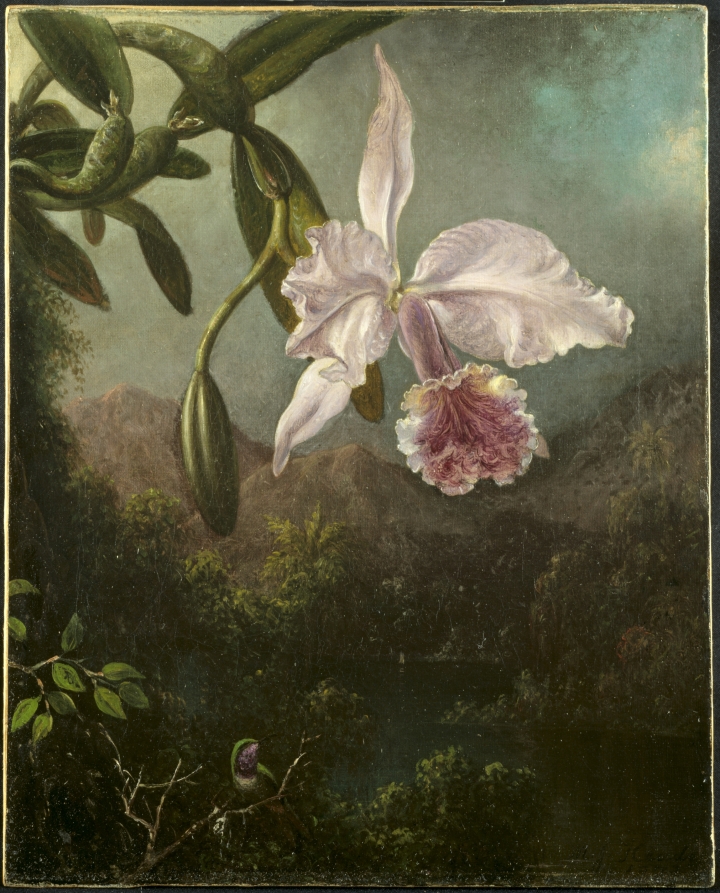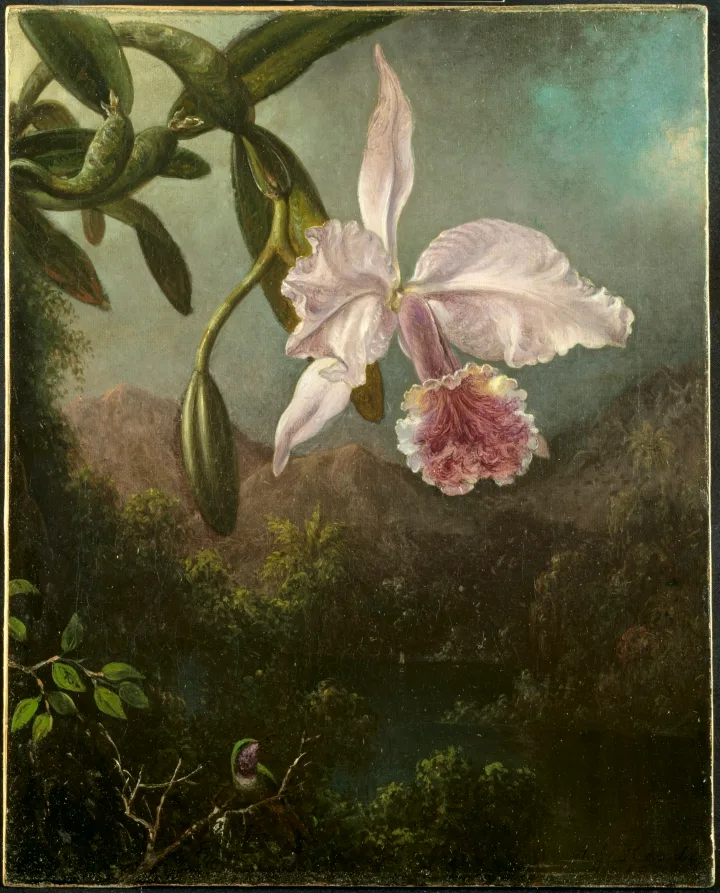
An orchid fills the foreground like a portrait, while a tiny bird and a deep landscape offer competing measures of scale.
The flower seems almost within reach. Pale petals spread across the upper half, while a deeper rose-colored center opens toward the viewer. Thick leaves and hanging buds connect the blossom to a branch, keeping them from reading as a detached botanical specimen. Behind, the forest recedes into a dim landscape, and a small bird occupies a much less conspicuous perch.
The museum links Heade’s tropical flower and bird paintings with three journeys to Central and South America made before this work. That biographical context explains a sustained interest, but the record does not identify this image as a precise view of one named site. Look at the difference between the enlarged foreground flower and the compressed distance. The painting joins close inspection with a broader environmental suggestion, allowing the orchid to dominate without eliminating the surrounding world. Its effect depends on that imbalance of attention as much as on the recognizability of the plant.
The museum does not name an exact location or identify every plant and bird species in this scene. Heade’s travels support the general context, but do not make this particular arrangement a scientifically scaled survey of a single habitat.