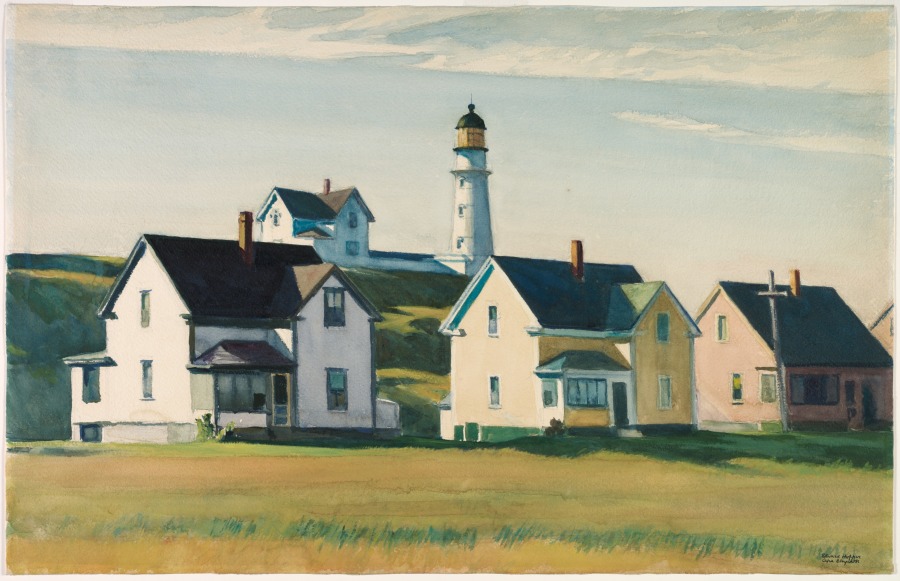
Similar houses become distinct through small changes of color, while the lighthouse ties their ordinary domestic forms to coastal work.
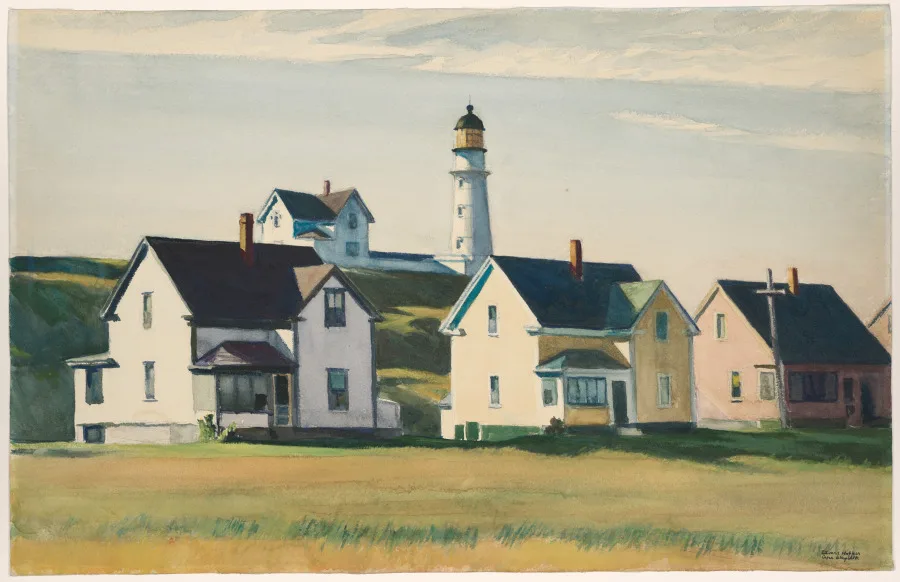
The buildings are related without being identical. Steep dark roofs repeat across the foreground, but wall colors shift from pale cream to yellow and pink. Behind them, the lighthouse rises as a narrow vertical above the slope. Broad grass and sky keep the scene open, while cast shadows make the buildings’ forms unusually clear.
Hopper made this watercolor during a 1929 visit to Maine, returning to the Cape Elizabeth lighthouse he had painted before. The museum identifies different functions within the cluster: a house for lighthouse keepers and three lower buildings occupied by coast guard families. What might seem a generic village is therefore a small landscape of work and domestic life. The museum also notes his use of distinct watercolor tones to register light on each structure. Compare repeated roof shapes with changing wall colors: the scene gains specificity through modest differences rather than through a crowd of people or a dramatic event.
The absence of figures does not prove that the village was abandoned or that its residents were lonely. The buildings’ uses come from museum context, while the emotional effect of the empty view remains open to interpretation.
What does the museum explain about the varied wall colors?
Practise looking at Lighthouse Village (also known as Cape Elizabeth) →