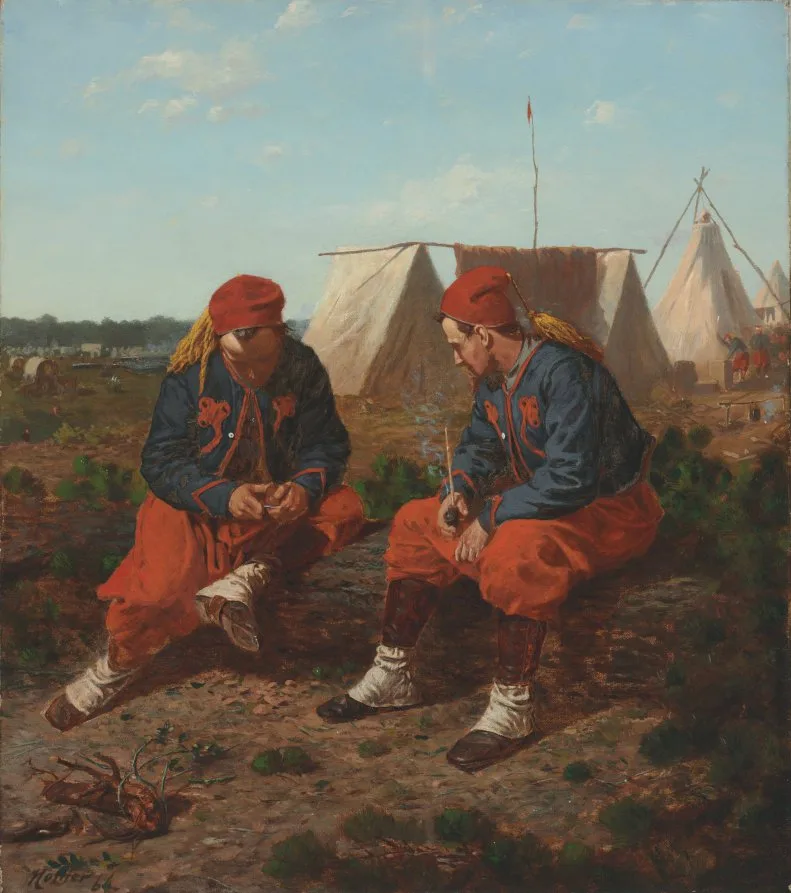
A carving task and a lit pipe place wartime attention on waiting, while the bright uniforms carry their own practical complication.
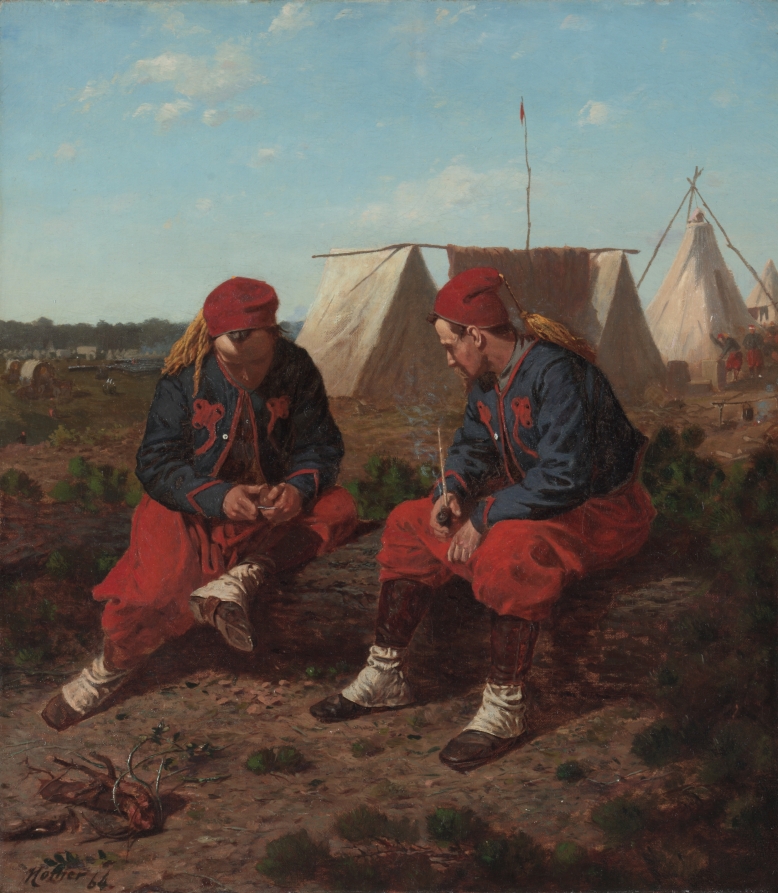
The two soldiers share a pause. One bends over a piece of wood, while the other holds a pipe and watches. Their bright red trousers and caps repeat across the pair, binding the figures visually before we notice the different tasks of their hands. Tents establish the encampment, but no battle enters the frame.
The museum identifies the men as Union Army volunteers during the American Civil War. Their conspicuous uniforms proved impractical because they could be readily spotted by sharpshooters. That context complicates the color’s immediate attractiveness. The title also matches a contemporary poem in which a soldier smokes and imagines returning home when the war ends, although the painting does not reveal these particular men’s thoughts. Compare the hands, the uniforms, and the quiet tents: Homer makes waiting and small practical activities part of war’s representation without requiring combat to be present in every image.
The poem supplies a related cultural context, not a transcript of either soldier’s thoughts. The museum does not name the men or identify an exact moment of waiting, and the quiet scene should not be mistaken for an absence of wartime danger.