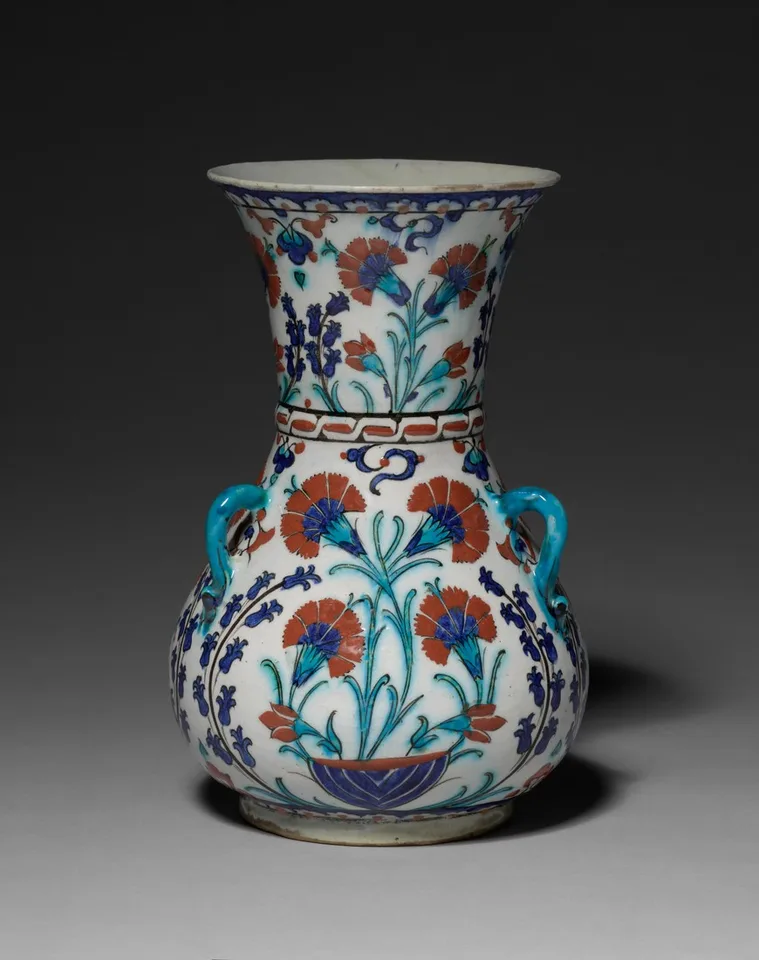
Look at the hanging loops before imagining this opaque lamp filled with light.
The turquoise loops offer an early clue to how this vessel was experienced: they could carry chains, allowing it to hang above the viewer. Its broad mouth and rounded body resemble a lamp, but its ceramic walls are opaque. The museum therefore suggests that illumination was probably not its main role. Suspended in a mosque or mausoleum, it could contribute to the appearance of the interior even without transmitting the glow expected from a glass lamp.
The floral decoration gives that suggestion a visible basis. Red carnations spread like fans, blue hyacinths rise on narrow stems, and the bouquets repeat across the swelling body and flaring neck. The museum identifies the object as Iznik fritware with underglaze painting, dated 1585–95. Its account also raises the possibility that ceramic lamps could affect the acoustics of religious spaces. That remains a proposal rather than a demonstrated use for this particular object. The safest reading begins with the actual loops, opaque body and carefully organized flowers, while keeping light, sound and architectural setting as separate questions.
The museum qualifies both the object’s main function and the suggestion of an acoustic role. Its shape alone does not prove that this opaque ceramic vessel illuminated a room.