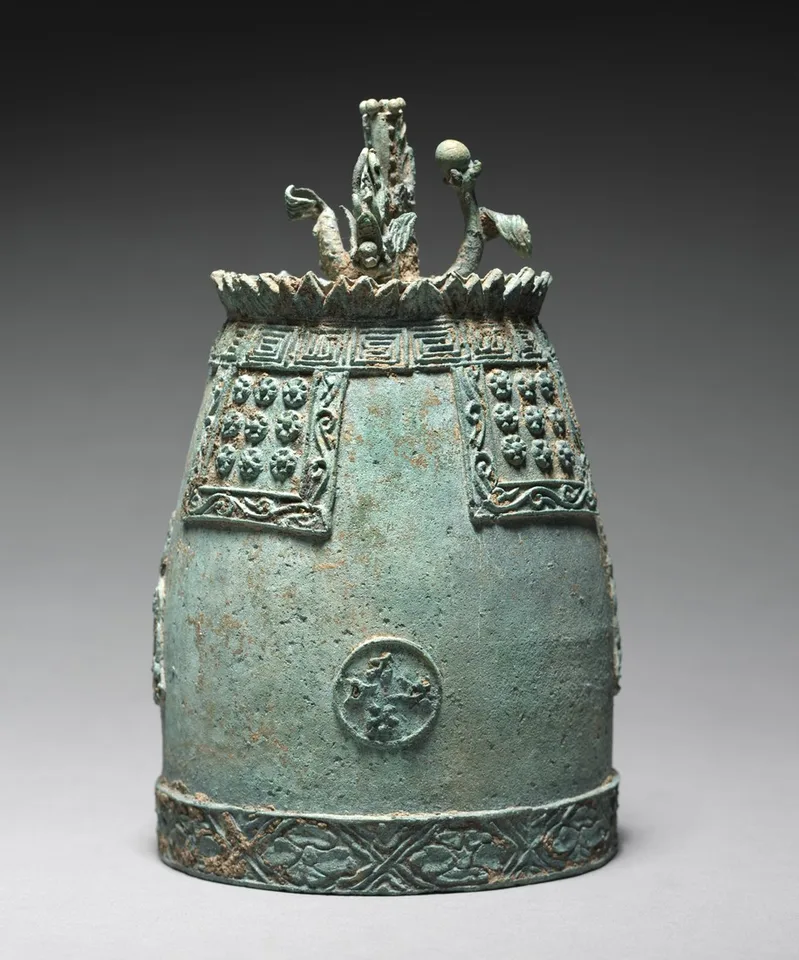
A dragon and a tube crown a small bell whose disappearing sound once made impermanence something listeners could experience.
The bell’s upper silhouette is unusually busy. A dragon curves beside a vertical tube, while rows of raised bosses decorate panels below the crown. Lower down, a circular medallion interrupts the quieter wall, and a patterned band runs around the flared mouth. These different zones reward close inspection even before the object is imagined sounding.
The museum dates the bell to 1226 through an inscription and describes three years of making. It was used in Buddhist indoor ritual and was probably suspended in a temple. The record relates its fading sound to impermanence: hearing the resonance disappear offers a sensory way to consider transience. The photograph can show the casting and suspension structure but cannot reproduce the original acoustics. That distinction matters because the object’s meaning was not confined to its visible ornament; it also depended on an event unfolding through time.
Temple suspension is probable, and the original sound is not recoverable from this photograph. The exact room and ritual sequence are not established by the visible decoration.