Read the
Picture
An open collection
Turkey, Iznik, Ottoman period (1299–1922) · Ceramic

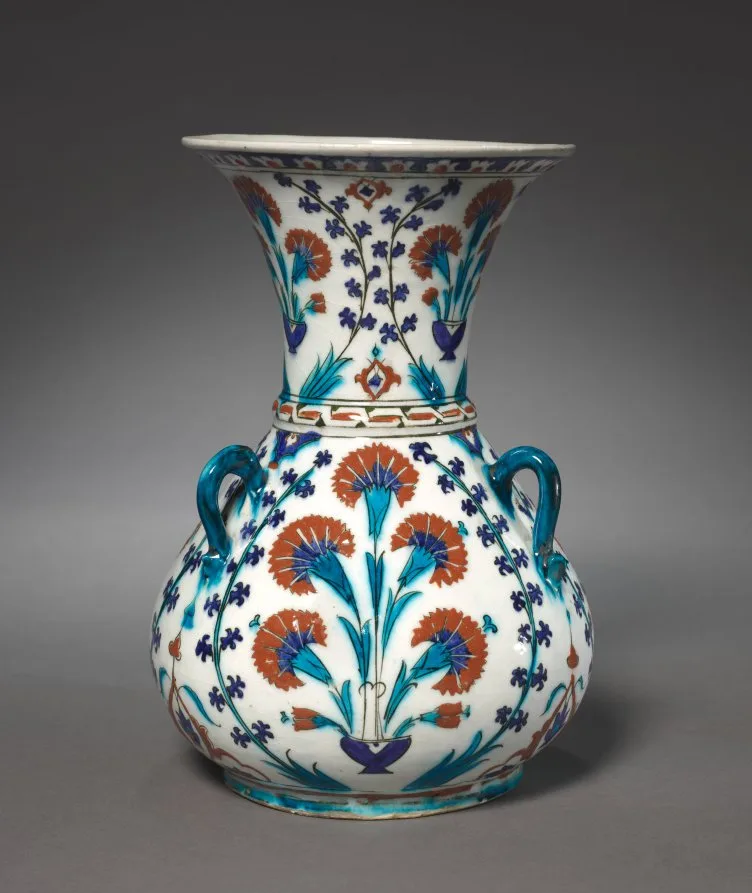
Mosque Lamp

Maker unrecorded · 1585–95

A ceramic vessel has a rounded body, narrow waist and tall flaring neck. Red carnations, blue flowers and green stems cover its white surface. Turquoise loops project from the shoulders at either side. Thin geometric bands encircle the waist and mouth, and a low circular foot supports the vessel against a dark background.
100%

Drag to move · Pinch or +/− to zoom · Arrow keys to pan · 0 to reset

The Cleveland Museum of Art · 1944.236 · Image: CC0Museum image ↗
A little context

Turquoise suspension loops and an opaque floral body complicate the expectation that every object called a lamp was chiefly made to illuminate.

The title invites us to imagine light, but the body presents a puzzle. Unlike a translucent shade, this decorated ceramic would hide much of a flame inside it. The museum therefore suggests that its principal role may have been ornamental, suspended in a mosque or mausoleum. Turquoise loops on the shoulders supply concrete evidence for hanging, while the flared neck and rounded body retain the familiar form of a mosque lamp.

Look at how the flowers adapt to that structure. Large red carnations occupy the broad lower body, while smaller stems climb the narrowing neck. The museum identifies the material as fritware, a mixture using quartz, glass frit, and a small proportion of clay to produce a light-coloured ceramic. It also mentions a possible acoustic role for vessels of this type, though that remains a possibility. The most useful reading begins with what this object clearly offers: suspension points, an opaque surface, and ornament arranged to be seen.

A careful reading

The museum proposes decoration as a likely main role and acoustics as a possibility; neither reconstructs this particular vessel’s use with certainty. Its title alone should not be treated as proof of how much light it produced.
Try your eye

Which visible feature most directly supports hanging the vessel from chains?

Where this reading begins

  • Mosque Lamp — The Cleveland Museum of Art. Primary collection record supports the identification, material history, attribution qualifications and specific contextual readings; visual observations refer to the supplied photograph. Museum record updated 2026-05-29; accessed 2026-11-13.

Our observations describe the supplied museum photograph. Historical identifications and context follow the cited collection record; interpretive limits are stated above. This is an independent guide, not a museum endorsement.

Image rights & attribution

Mosque Lamp, 1585–95. Turkey, Iznik, Ottoman period (1299–1922). Fritware with underglaze design; overall: 28.4 x 19.5 cm (11 3/16 x 7 11/16 in.); diameter of rim: 17 cm (6 11/16 in.). The Cleveland Museum of Art, Purchase from the J. H. Wade Fund, 1944.236

Individual API record marked CC0; checked 2026-11-13. CC0 1.0 dedication. Record date: 2026-05-29 06:22:23.417000. Museum web photograph retained; responsive WebP and zoom versions resized and recompressed from supplied photographs; numbered annotations are a separate overlay.