Surfaces set the rules
A motif does not float free of its support. These four works show how reserved silk, folding panels, a circular dish, and an opaque lamp shape what an image can do. Look for edges, openings, and interruptions, then ask how the object’s original encounter differed from the stable front-facing photograph on your screen.
Begin the journey ↓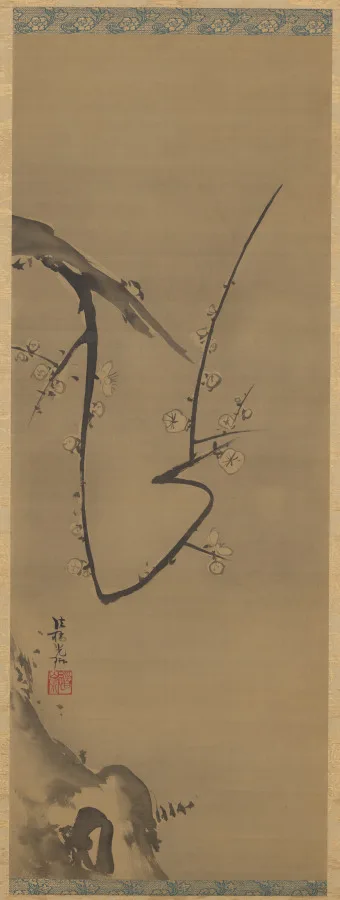
Leave a flower unpainted
The blossoms emerge because selected silk was reserved from the surrounding wash. A pale area can be a planned technique rather than a later layer of white pigment added over darkness.
Carry this question: What does the painter gain by preserving the support itself?
Open the artwork ↗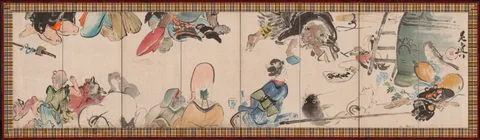
A gathering across folds
The familiar popular figures continue across eight panels. In a physical screen, changing angles could alter their relationships, while the photograph makes the entire gathering available in a stable spread.
Carry this question: How might a folded panel change who appears beside whom?
Open the artwork ↗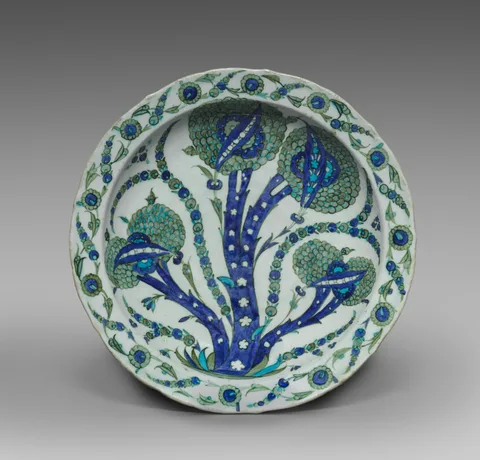
A plant meets a circle
The central artichoke-like design and surrounding garland respond to the dish’s circular field. Follow the rim as a boundary before treating the floral surface as an unrestricted garden scene.
Carry this question: How does the rim help organise the plants?
Open the artwork ↗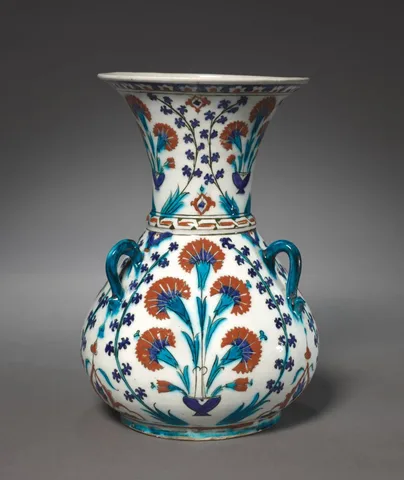
A lamp that is opaque
The ceramic neck and body do not transmit light like transparent glass. The museum therefore questions a primarily illuminating function, while suspension loops still reveal how the object could be hung.
Carry this question: What does the material make you reconsider about the familiar word lamp?
Open the artwork ↗Look at a pair more closely
- Two ways to make a pale blossom
Shen Zhou’s outlines and Kōrin’s reserved silk
- A dish organises a design
Japanese plovers and Ottoman artichoke-like forms
Read with the sources
Historical context follows the individual museum records linked on each artwork page. These routes make original comparisons of visible form; resemblance alone is not evidence of shared meaning or direct influence.