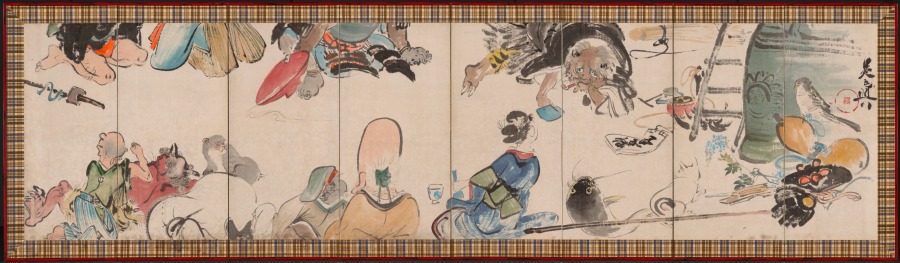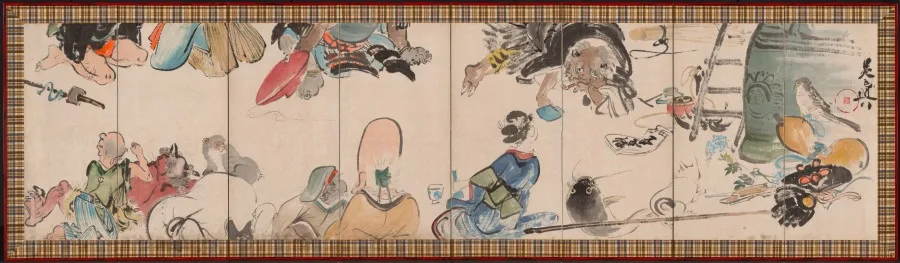
A crowd of familiar popular figures spills across an eight-panel screen, turning souvenir imagery into a witty shared performance.
The screen does not centre on one hero. Figures appear at different heights and orientations, making the eye travel across a lively gathering. Some occupy the lower edge as if sharing a stage; others seem to spill in from above. The repeated panel divisions give the busy scene a physical rhythm that a single flat illustration would not have.
The museum identifies stock characters from Ōtsu-e, souvenir paintings sold to travellers on the Tōkaidō route. Shibata Zeshin drew on an already familiar popular repertoire, so recognition and playful rearrangement were part of the appeal. His career crossed the transition from Edo to Meiji rule, when forms of urban entertainment and everyday culture were changing. This context does not require identifying every small character from a thumbnail. Begin with the gathering’s variety of poses and the way figures cross divisions. Compare a single actor print to see how individual recognition differs from a crowd assembled out of shared visual memory.
The museum identifies the Ōtsu-e repertoire, but this introduction does not assign unsupported names to every small figure. The flattened photograph cannot fully reproduce the changing angles of an opened folding screen.