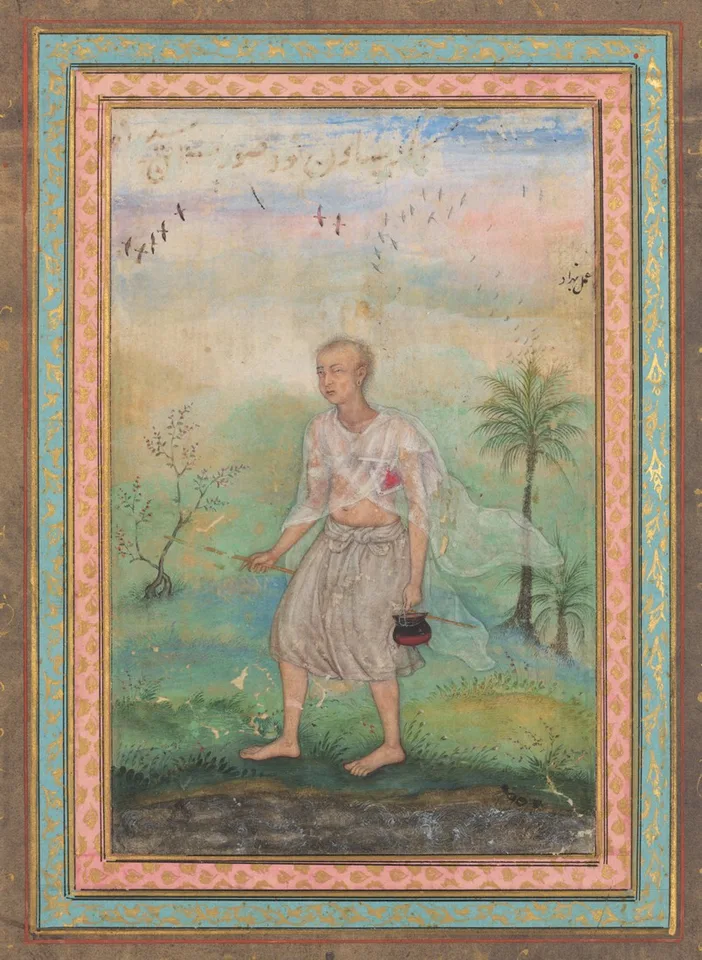
Look at the small objects carried by a white-clad monk beside the river.
The monk’s belongings are small, but they organize the portrait. A red-covered manuscript rests beneath his arm, a slim staff crosses the body’s lower area, and a dark pot hangs from one hand. The pale clothing and bare feet keep the figure distinct from the green bank. Behind him, delicate plants and a softly coloured sky provide space without competing with his presence. The museum identifies the objects as a Jain ascetic’s basic equipment, with the manuscript also alluding to learning.
The painting is attributed in the current catalogue to Basavana and was made for the collection of the Mughal emperor Akbar, whose court hosted discussions among different religious groups. The record connects the portrait with Akbar’s interest in Jain teaching. Its inscriptions complicate easy identification: one later attribution to the Persian painter Bihzad is described as spurious, while a partially erased inscription naming Basawan may also contain part of a monk’s name. The museum proposes several possibilities rather than choosing a certain sitter. The portrait thus preserves a carefully observed individual whose exact identity remains unresolved.
The monk’s exact identity is uncertain. The museum rejects a later inscription attributing the work to Bihzad; the surviving writing should not override the current qualified catalogue discussion.
Which approach best handles the later inscription naming Bihzad?
Practise looking at Jain Ascetic Walking Along a Riverbank →