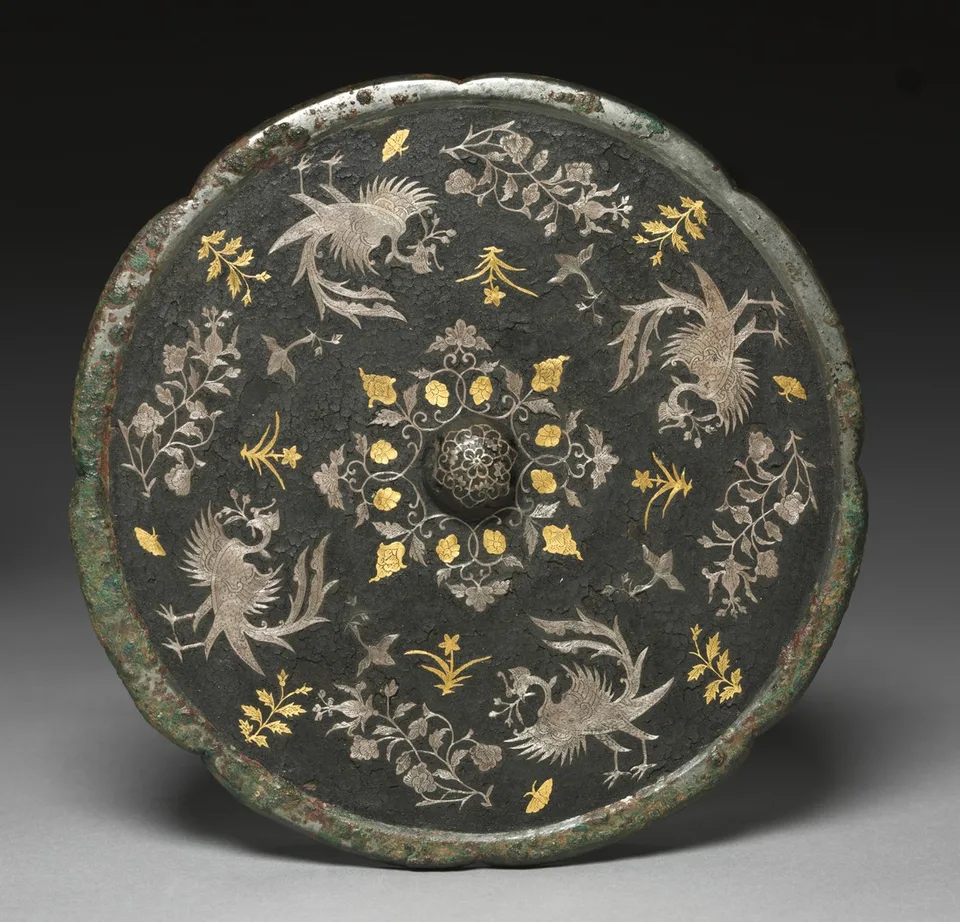
The side that cannot reflect your face becomes a dark garden of thin gold and silver birds, blossoms and butterflies.
This photograph shows the decorated back of a mirror. The central knob could help a user lift the object, while the reflecting surface lay on the other side. Around that practical centre, long-tailed birds turn through a field of leaves, smaller birds and butterflies. Pale silver and warm gold make the dark ground seem densely inhabited without filling every space.
The museum calls this a pingtuo mirror: extremely thin sheets of precious metal were set into a lacquer ground. It connects aspects of the floral and bird ornament with Persian and Central Asian designs circulating during the Tang period. Comparable luxury mirrors could function as diplomatic gifts. That wider history gives the decoration an international setting, but it does not establish that this particular mirror travelled on a known embassy. Its documented modern provenance begins with a dealer in Kyoto before the museum’s acquisition.
This is the ornamented back, not the reflecting face. Comparison with diplomatic gifts does not establish a specific diplomatic journey for this individual mirror.
Why is the central knob relevant to understanding the object?
Practise looking at Mirror with Phoenixes, Birds, Butterflies, and Floral Sprays →