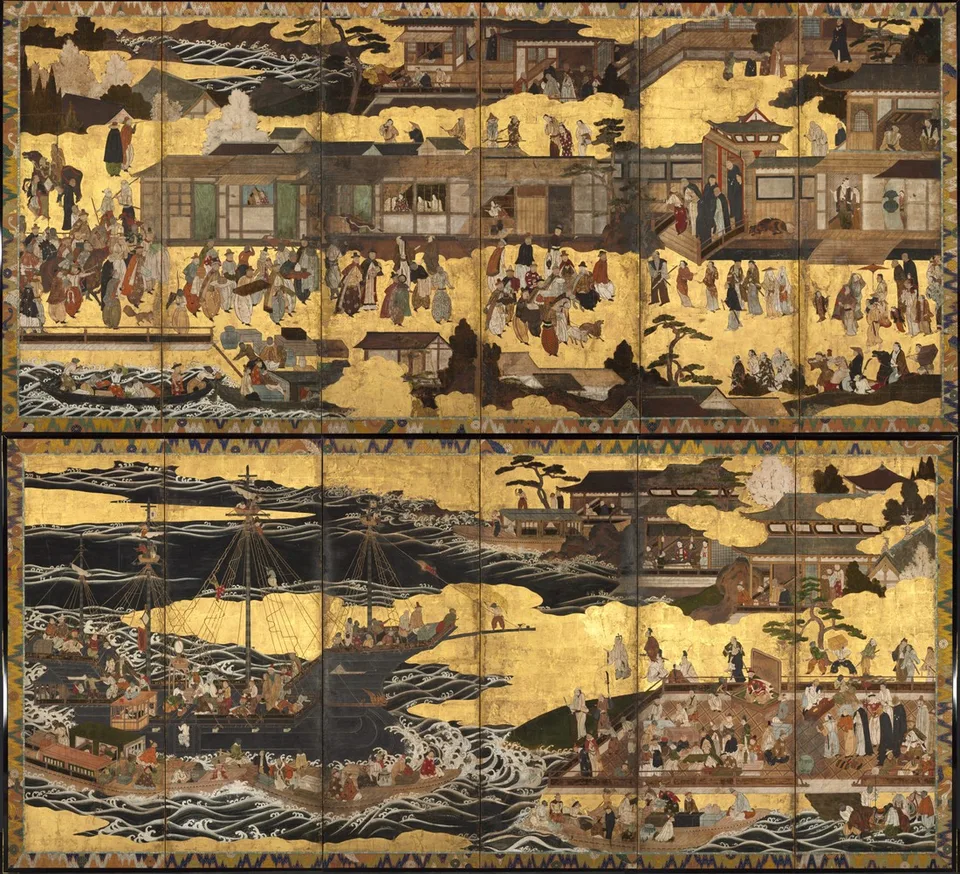
Ships, crowds and golden clouds turn an overseas arrival into a Japanese picture of movement, exchange and unfamiliar appearance.
Read across the shore before trying to count the visitors. Ships, landing places, streets and buildings distribute activity across both screens, while gold clouds interrupt continuous space. Those interruptions make it possible to present several kinds of encounter together. The dark vessels and white wave lines contrast sharply with the crowded land, connecting overseas travel with the spectacle of arrival.
The museum identifies the visitors as almost certainly Portuguese, partly because Roman Catholic priests accompany them. The historical label translated as “Southern Barbarians” reflects a Japanese classification based on the direction from which the ships arrived; it is not a neutral judgement to adopt today. The screens offer a Japanese representation of foreign merchants and religious visitors around 1600. Costume and arrangement matter to that representation, but the image does not supply an objective census of everyone present at one securely documented landing.
The title preserves a historical Japanese label for foreign visitors. The Portuguese identification is highly probable, and the screens should not be read as a literal record of one landing.