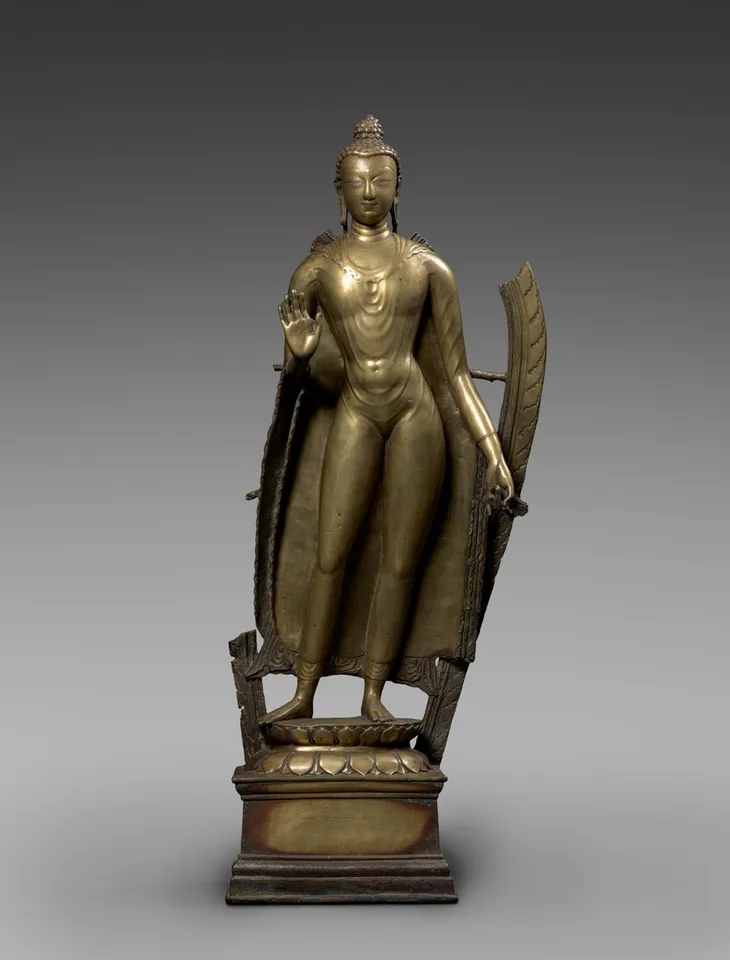
A foot projects beyond the lotus while a raised palm offers reassurance, bringing a transcendent figure toward the viewer’s world.
The raised palm and slightly advanced foot make this standing figure feel approachable. One hand reassures, while the other gathers the end of the robe. The smooth body contrasts with the more patterned lotus pedestal, and the foot’s small extension beyond it suggests a movement toward the space of a viewer. Such a slight change in balance can be more expressive than a large gesture.
The museum identifies the sculpture with Kashmir and reads its worn surfaces as evidence of ritual washing and other ablutions. A Tibetan inscription records ownership by the royal monk Nagaraja, active around the turn of the eleventh century. The object thus preserves both bodily signs of worship and a textual connection with Tibet. Its role in the movement of Buddhist images and artistic models is more specific than a general claim of influence: material wear and inscription provide different kinds of evidence for its history.
Wear and inscription support the museum’s historical interpretation, but do not reconstruct every movement or ritual use. The partial backing also limits our sense of the original complete silhouette.