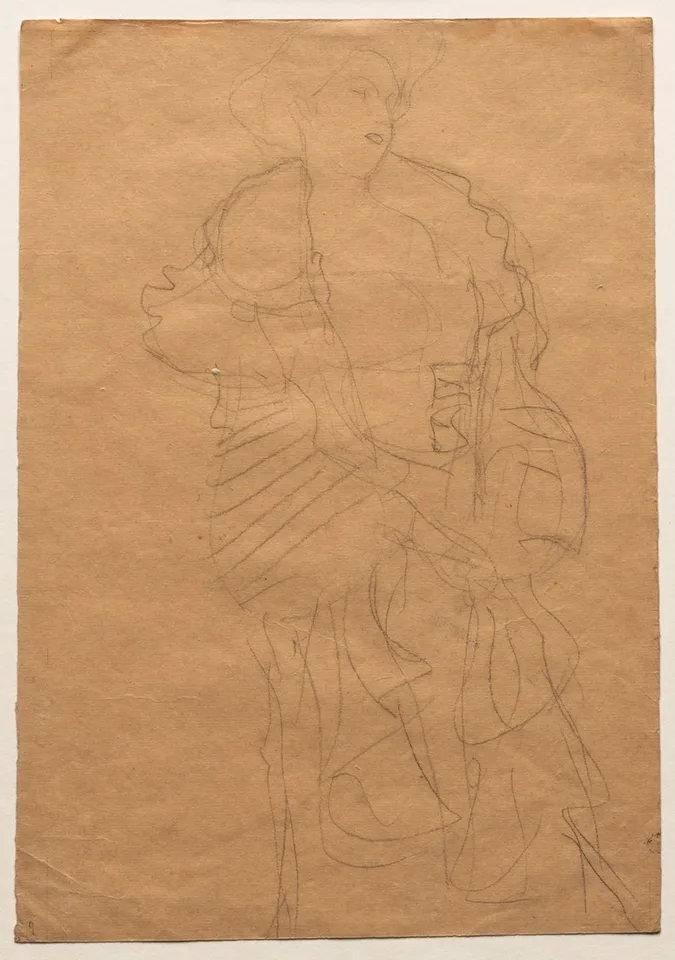
A few searching lines hold an elaborate dress together, showing a portrait before color and surface decoration take over.
The face is lightly indicated, while the dress spreads into a much larger network of curves. Some lines repeat or overlap, especially around the sleeves and lower skirt. The joined hands give the figure a central point of stillness within those changing outlines. With no painted background to help, the body must emerge from the relationship between contour and empty paper.
Klimt made this sheet in preparation for a portrait of Hermine Gallia, now in London’s National Gallery. The museum identifies Gallia as a member of a wealthy Jewish family in Vienna who commissioned the work through the city’s progressive artistic circles. It suggests the drawing may have been made from life because of its quick, exploratory handling. That possibility remains distinct from certainty. The sheet is valuable precisely because it preserves decisions in motion: the dress’s size and structure are being recorded without the finished canvas’s fuller decorative effect.
The museum says the sheet may have been drawn from life, not that this is proven. Its exploratory lines should not be interpreted as a complete account of the final painting.