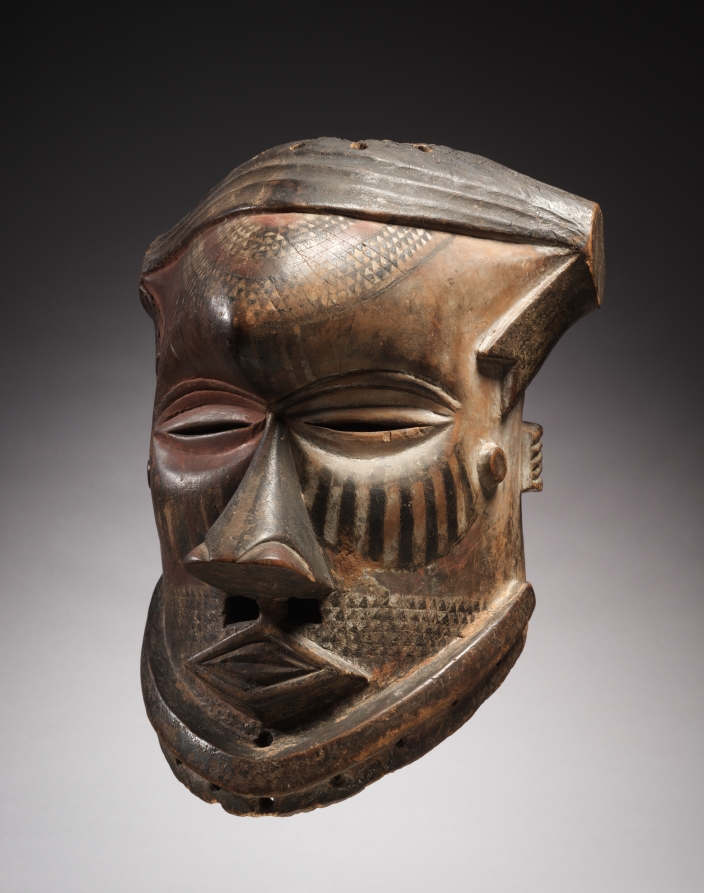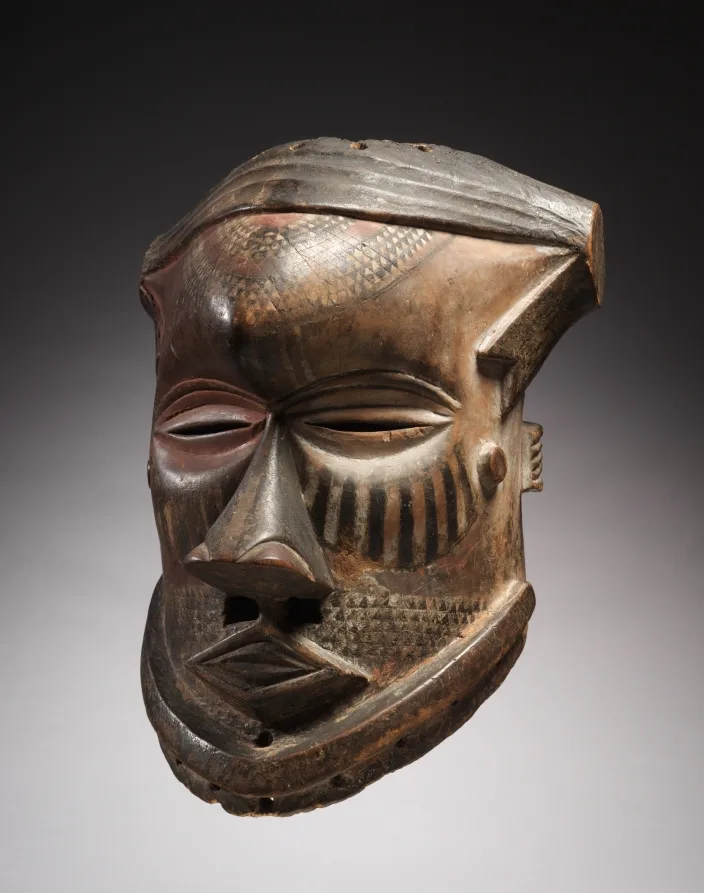
An enlarged forehead, narrow eyes and painted cheeks create a character whose meaning depended on a living performance.
This face is organized through strong contrasts: the broad upper head against the small eye openings, the projecting nose against recessed cheeks, and curved jaw against angular planes. Painted stripes and incised patterns add further rhythms to the carved form. The result was meant to become part of a moving character, not simply to imitate a stationary human head.
In the Bushoong setting described by the museum, bwoom joins a female and another male masked character in performances concerning the origins of the Kuba kingdom. Bwoom is commonly associated with a hunter-gatherer figure. Yet the same named mask can appear in other settings outside the capital, including men's initiation associations. Performance, costume, occasion and audience help establish its role. The museum notes that eagle feathers could be added for special appearances; their absence from this photograph is a reminder that a collected mask is only part of its former presence.
Bwoom does not have one fixed role across all Kuba communities and occasions. This photograph shows the surviving mask without its full costume, performer, movement or sound.