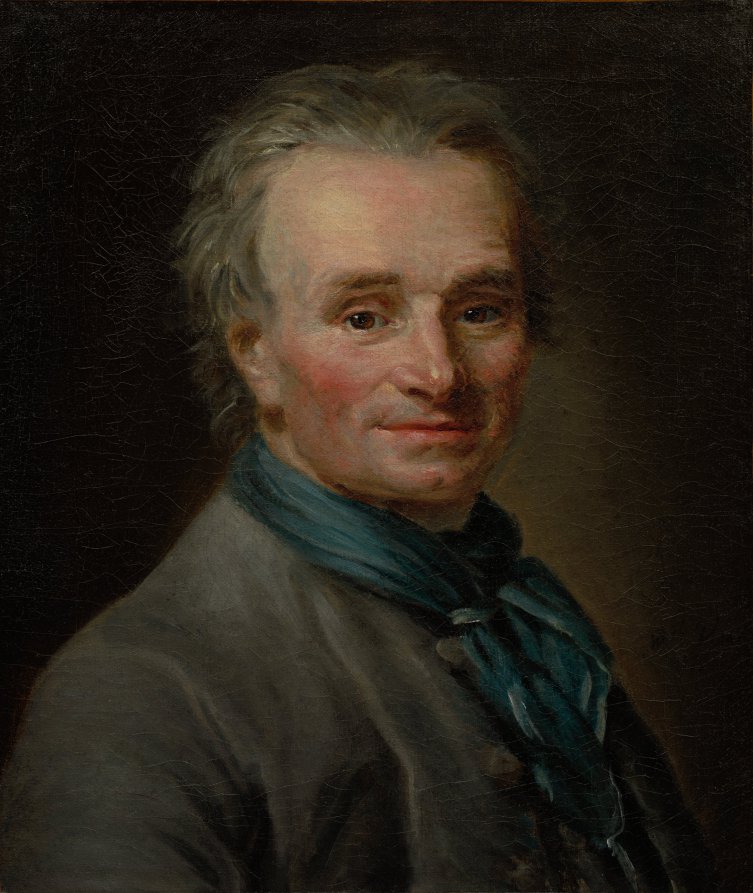
A sculptor appears without tools or marble: the working coat, lively gaze, and soft paint establish his presence.
There is no chisel here to announce a profession. Vigée-LeBrun concentrates on the sculptor Jean-Baptiste Lemoyne’s face, short gray hair, scarf, and working clothes. The head turns toward us while the body remains angled away. That small disagreement of directions makes the encounter feel responsive, as though someone has briefly interrupted him. The slight smile offers a point of contact without telling us exactly what he thinks.
The museum explains that this signed painting reinterprets a pastel by Maurice-Quentin de La Tour. It is therefore both a portrait and a conversation with an earlier image. Vigée-LeBrun had begun in pastel, and the museum connects the soft handling here with that training. Look between the warm cheek and the less sharply described coat: different degrees of definition guide attention. Professional identity emerges through a modest presentation rather than through ceremonial costume or a conspicuous display of accomplishments.
The museum reads familiarity in this portrait, but an expression cannot independently prove a personal relationship. The earlier pastel is an acknowledged source, so apparent immediacy should not be confused with an unmediated encounter.
Which observation best supports the portrait’s informal presentation?
Practise looking at Portrait of Jean-Baptiste Lemoyne the Younger →