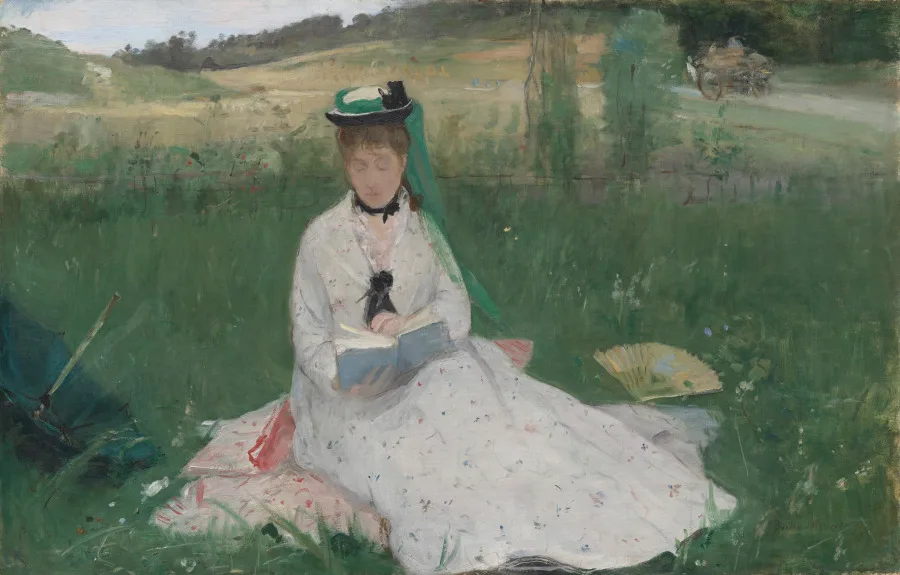
The reader’s lowered eyes changed during painting: visible absorption and hidden revision tell two different parts of this picture’s story.
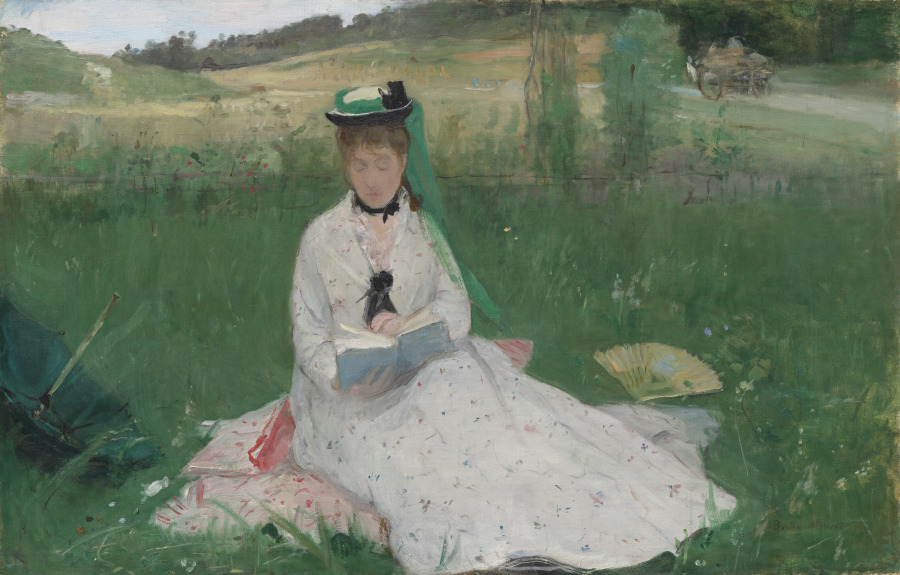
A white dress spreads into the grass, catching the outdoor light rather than separating neatly from it. The small floral marks on its surface echo the surrounding meadow. Morisot’s sister Edma posed for this scene, but the activity is as important as the identity: the woman’s attention belongs to her book. A fan and parasol set aside nearby help establish a moment of outdoor leisure.
The museum’s X-ray examination revealed a revision beneath the finished surface: Edma’s eyes originally looked outward toward the viewer. That earlier state is not something we can recover simply by enlarging this photograph. The present downward gaze changes our relationship to the figure, allowing us to observe someone absorbed in another activity. Move between the face, the open book, and the discarded accessories. Together they construct a convincing situation, while technical research shows that its apparently casual intimacy emerged through choices and changes.
The earlier outward gaze is known through X-ray examination, not visible through ordinary zoom. Edma posed for the work, but the painting is a composed scene rather than proof of exactly how she spent a particular afternoon.